
Guides / Estimating
How to estimate an artificial turf job, step by step
Measure, lay out the rolls, price every line item, then add overhead and margin. Here is the full process with a worked backyard example.
By Josh West, co-founder of TurfEstimator | November 12, 2026 | 8 min read
To estimate an artificial turf job, measure the area, lay out the rolls before you order anything, then price every line item: turf, excavation and haul-away, base, weed barrier, seam tape, nails and edging, infill, equipment and labor. Add your overhead, set your margin, and send the customer two or three options.
Most bad turf estimates miss in the same two places. The turf quantity comes from square footage instead of a roll layout, and the labor is a guess. Fix those two and the rest of the estimate is bookkeeping.
Key takeaways
- Order turf from a roll layout, not from square footage.
- Price every line item at your cost first, then add overhead and margin.
- Margin and markup are different numbers. A 35% margin needs a 54% markup.
- Send good, better and best options so the customer picks between your prices.
- Most jobs are won or lost in the follow-up, not the first visit.
Measure the yard
Every number on the estimate comes from the measurement, so get it right once. Pick the tool that fits the job.
- Measuring wheel: fast and cheap for rectangles and straight runs. Shoot the long sides twice and take the average.
- Laser measure: best for distances between hard surfaces, like house wall to fence, where a wheel bumps over things.
- Satellite measurement: good for a first number before you ever drive out, and for pricing leads at the desk. Tree cover and shadows can hide edges, so confirm on site.
- Moasure or a similar device: walks the perimeter and records curves, which is where the wheel falls apart. It exports a drawing you can lay rolls on.
Write down more than the area. Note the perimeter and what each edge meets (concrete, pavers, planting bed, fence), the access width for your equipment, slopes, drains, sprinkler heads to cap, and any trees or stumps. Each of those changes a line item later.
Tip: Measure the longest straight edge on every job. It usually decides which way the rolls run.
Lay out the rolls before you order
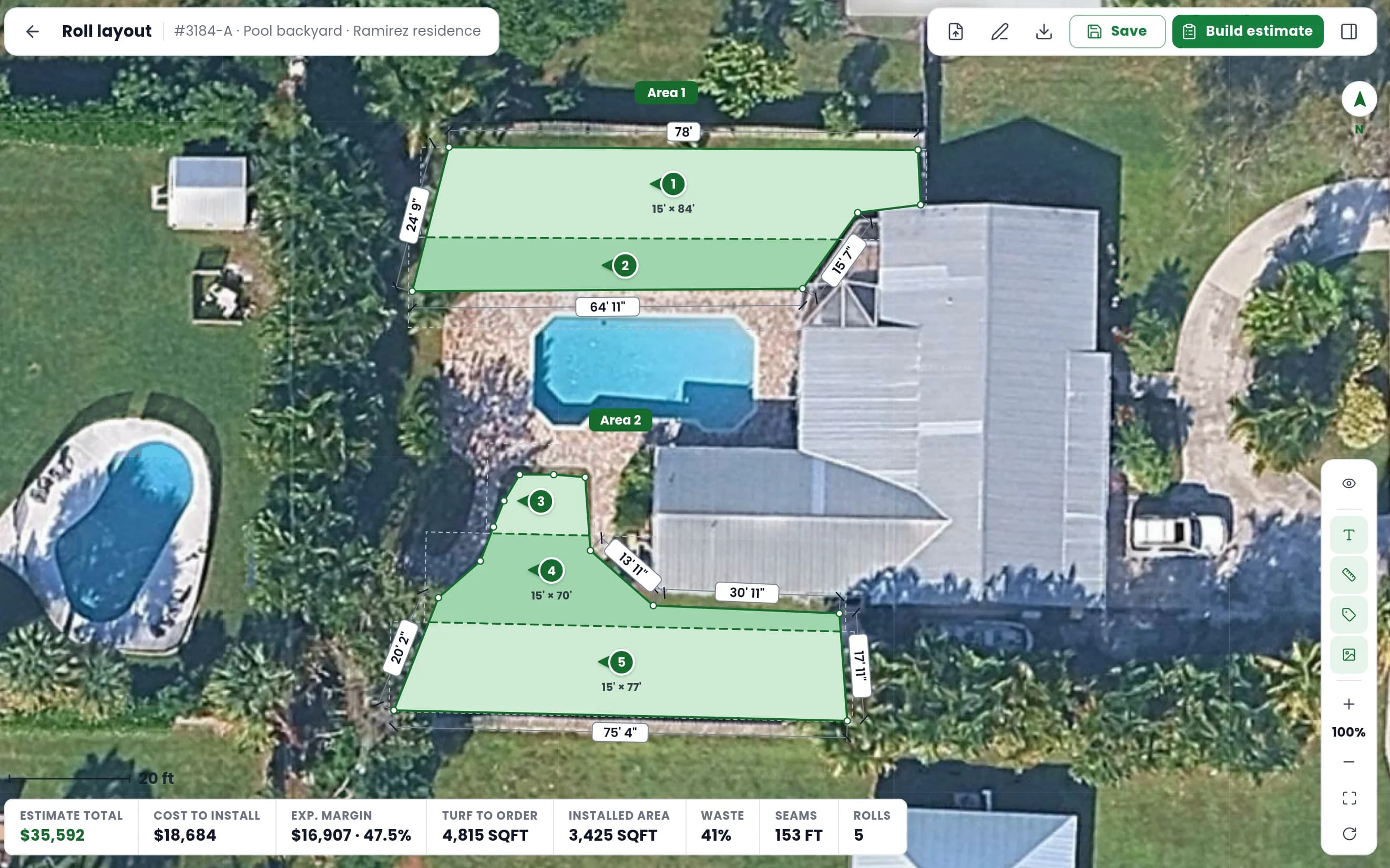
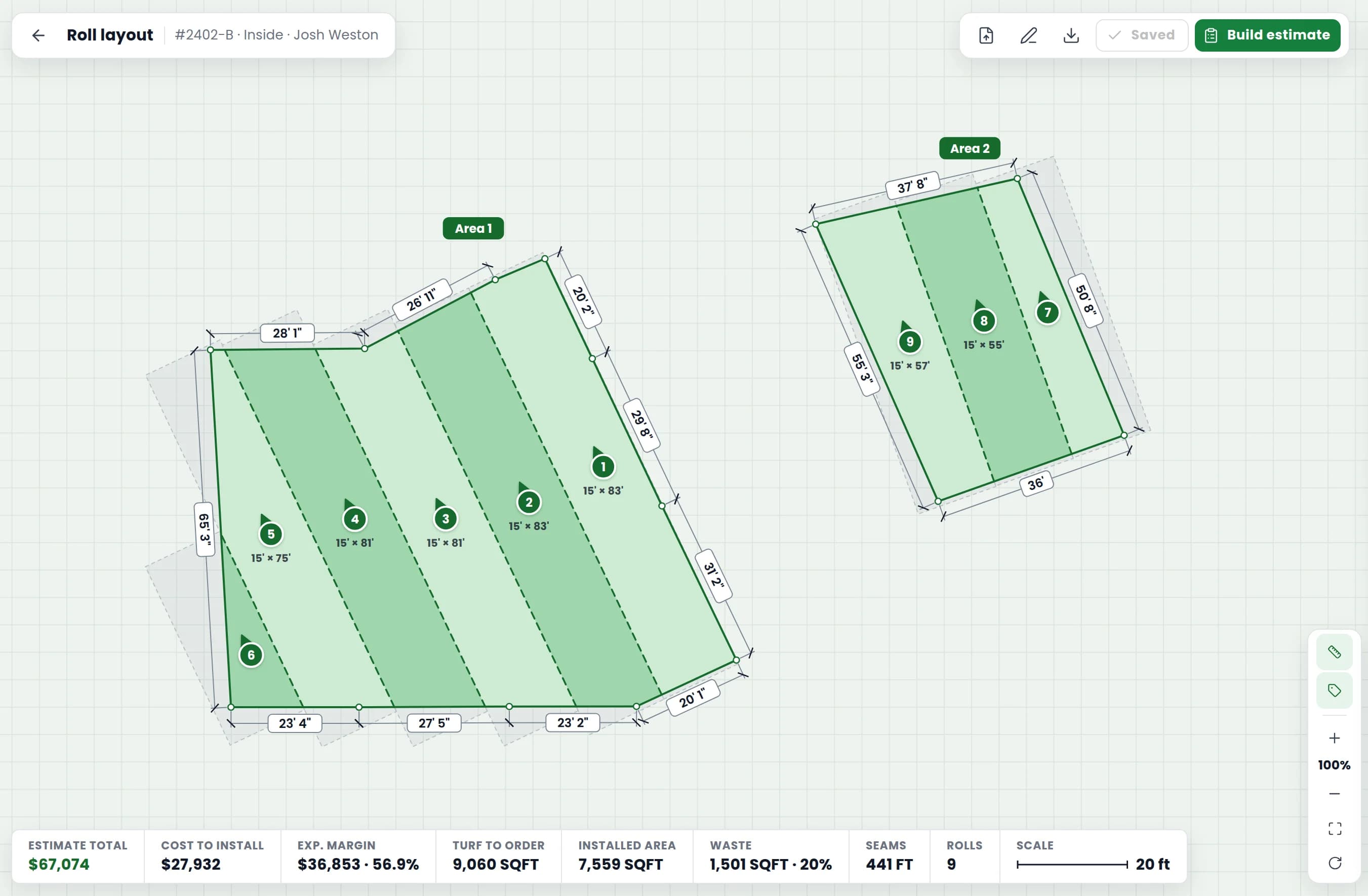
Turf comes in rolls 15 ft wide and 100 ft long, cut to length. A 1,000 sqft yard never takes exactly 1,000 sqft of turf. Depending on the shape and the roll direction, you might order 1,050 sqft or 1,300 sqft. That gap is real money on every job.
Lay it out on paper or in software before you write a turf number:
- Pick a roll direction. All pieces need the grain running the same way, ideally toward the main viewing spot, like the back patio door.
- Fill the area with 15 ft strips in that direction and note each piece length, plus a few inches of trim on each end.
- Mark every seam. Keep seams out of walk paths and away from the patio view where you can.
- Total the pieces. That is your turf order. Subtract the area and you have your waste.
- Try the other direction and compare. Pick the layout with less waste and fewer, better placed seams.
This is also where the seam footage comes from, which drives seam tape and glue. In TurfEstimator, the roll layout tool does this from a satellite measurement, a DXF or CSV file from CAD or a Moasure, a picture or a drawing. It finds the best roll direction, numbers the rolls, marks every seam and shows the waste, then gives the crew a cut list.
Price every line item at your cost
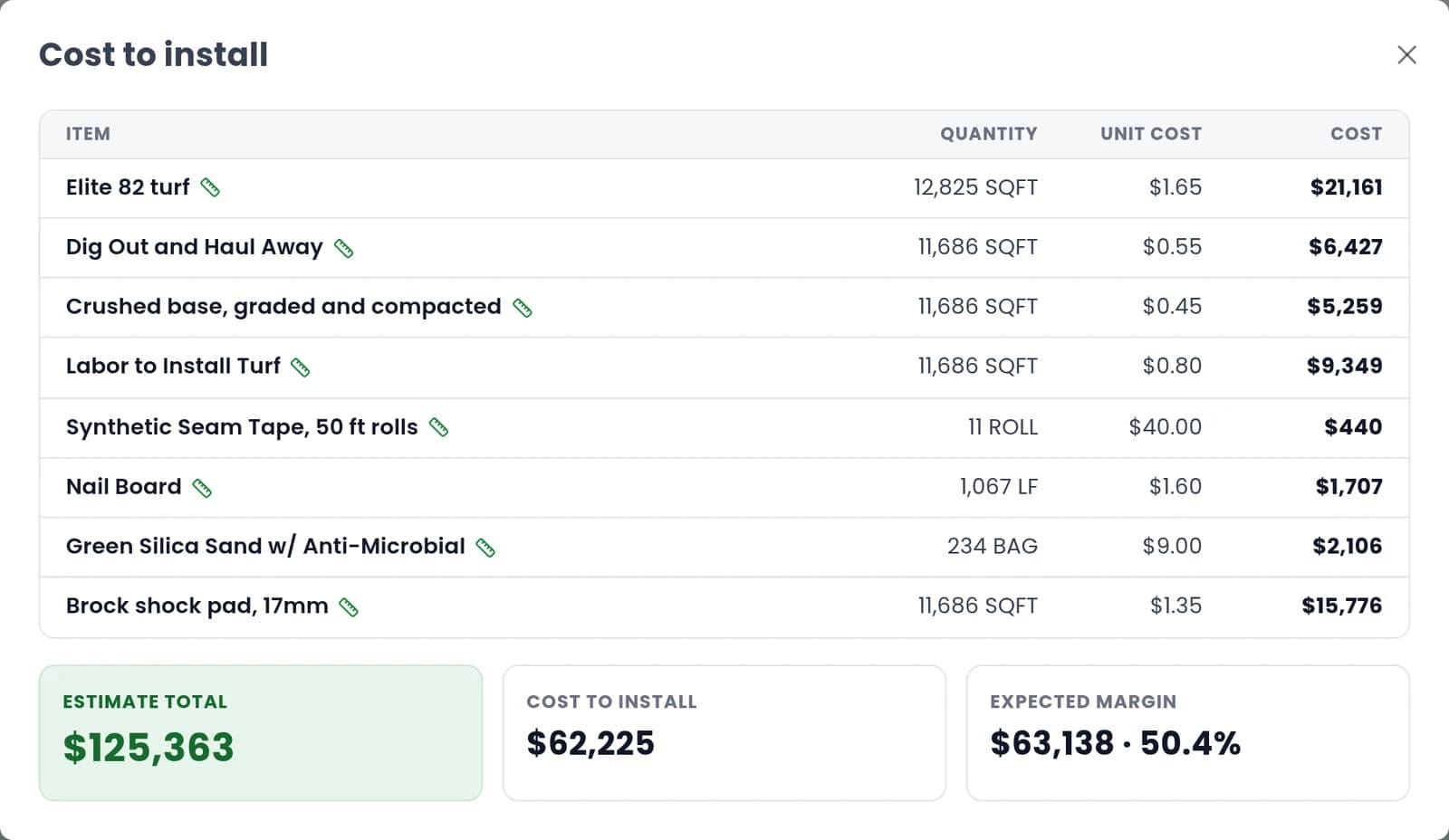
Build the estimate at cost first. Markup comes later, in one place, so you can see what the job really costs you.
- Turf: the ordered square footage from the layout, not the area, at your supplier price. Add freight if you pay it.
- Excavation and haul-away: take out sod and soil to the depth you need, typically 3 to 4 inches. Price dump fees and truck trips. Loose dirt takes up more room than it did in the ground, so plan for more loads than the math says.
- Base: crushed rock or decomposed granite, typically 3 to 4 inches compacted. Order extra over the in-place volume because it compacts down.
- Weed barrier: the area plus overlap.
- Seam tape and glue: from the seam footage in the layout.
- Nails, staples, edging or nail board: nails around the perimeter and through the field, plus edging or nail board wherever turf meets soil or a planting bed instead of concrete.
- Infill: pounds per sqft depend on the turf and the manufacturer's spec. Silica sand, coated sand or a pet infill. Follow the spec, then buy whole bags.
- Equipment: plate compactor, sod cutter, mini skid steer or power broom, owned or rented. Owned gear still costs you per day.
- Labor: crew hours times your loaded hourly cost, meaning wages plus payroll taxes, workers comp and anything else you pay per hour.
Labor is the line most estimators guess. Look back at your timesheets on similar jobs. If a 3-person crew usually does a plain 1,000 sqft backyard in two days, that is 48 hours, and that is your starting point. Add time for tight access, slopes, heavy roots or long wheelbarrow runs.
A worked example: a 1,176 sqft backyard
Say a made-up backyard is 42 ft by 28 ft, 1,176 sqft, flat, with concrete along the house and planting beds on the other three sides. Running two 15 ft rolls along the 42 ft side covers 30 ft of the 28 ft width. That is 1,260 sqft ordered, 84 sqft of waste (about 7%), and one 42 ft seam. About 100 ft of edge meets planting beds and needs nail board.
The prices below are example numbers. Use your own supplier and labor costs.
| Line item | Quantity | Your cost |
|---|---|---|
| Turf | 1,260 sqft at $2.50 | $3,150 |
| Excavation, dump fees, trucking | about 13 cu yd in place | $550 |
| Base rock, 3 in compacted | 13 cu yd at $45 | $585 |
| Weed barrier | 1 roll | $120 |
| Seam tape and glue | 42 ft seam | $40 |
| Nails | 1 box | $60 |
| Nail board edging | 100 ft at $2.50 | $250 |
| Infill, 1.5 lb per sqft (example spec) | 36 bags of 50 lb at $9 | $324 |
| Equipment | compactor, sod cutter | $350 |
| Labor | 3 people, 2 days, 48 hr at $30 | $1,440 |
| Overhead share | see next section | $700 |
| Total cost | $7,569 |
At a 35% gross margin, the price is $7,569 divided by 0.65, which is $11,645. Round to $11,650. That works out to about $9.91 per sqft of the yard. Notice the turf is only about 42% of the cost. If you priced this job as turf cost times two, you would lose money.
Add overhead, then margin
Overhead is everything you pay whether or not a crew is on a job: the shop, trucks, insurance, phones, software, office help and your own salary. Add it up for a year and divide by the crew days you expect to work. That gives you an overhead cost per crew day. In the example, two crew days at a made-up $350 per day is the $700 overhead line.
Then set margin, and do not confuse it with markup.
- Markup is a percent of cost. $7,569 with a 54% markup is about $11,656.
- Margin is a percent of price. $11,650 with $7,569 in cost is a 35% margin.
- To hit a target margin, divide cost by (1 minus the margin). For 35%, divide by 0.65.
Plenty of installers say they mark up 35% and think they make 35%. They make about 26%. On a year of jobs that difference pays a crew member. TurfEstimator shows the cost to install and the expected margin on every estimate before you send it, so you see a thin job before the customer signs it.
Tip: Set a minimum job price. Small jobs carry the same drive time, setup and haul-away as big ones.
Give good, better and best options
One price asks the customer yes or no. Three prices ask which one. Build the estimate once, then change only the turf and a few add-ons for each option.
- Good: a solid entry turf and the base and install you would stand behind on any job.
- Better: a thicker or more natural looking turf. In the example, a turf that costs $0.75 more per sqft adds $945 in cost on 1,260 sqft, and about $1,455 to the price at the same margin.
- Best: premium turf plus a pet infill, upgraded edging or a putting green add-on.
Never cut base depth or compaction to make the cheap option cheaper. The callback on a low spot costs more than the job made. Keep the install the same and let the turf and add-ons change the price. TurfEstimator estimates support templates, packages, good, better and best options and add-ons, so the three versions take minutes instead of three separate estimates.
Send it fast and follow up
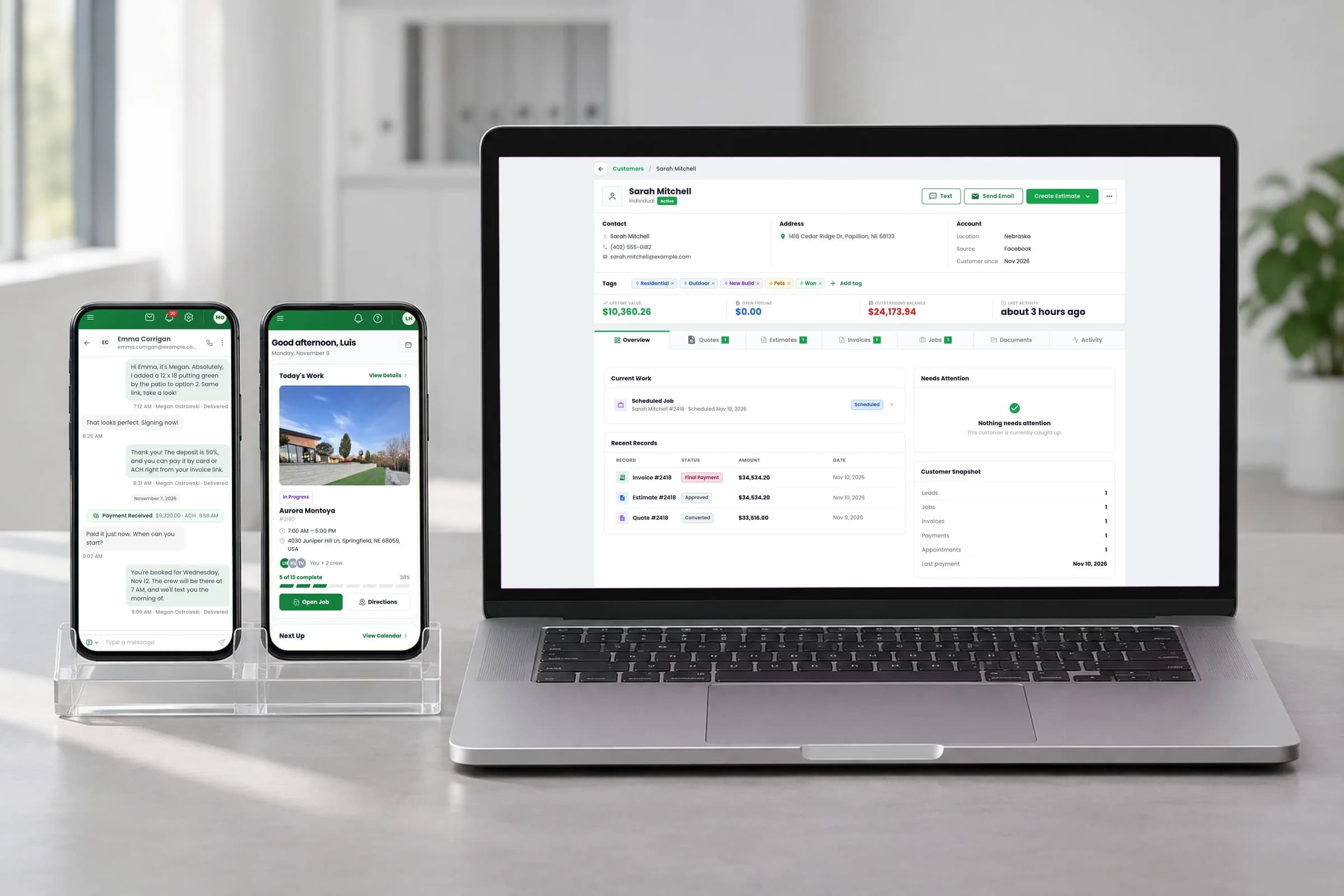
The installer who gets a clear estimate to the customer first, often the same day, wins a lot of jobs on speed alone. Send it in a form they can read on a phone, with the options side by side, a short scope of work, and a way to sign and pay the deposit right there.
Then follow up on a schedule, not when you remember:
- Day 1: confirm they got it and ask if they have questions.
- Day 3: answer the common one before they ask, like drainage, pets or how long it takes.
- Day 7: ask if they want to go ahead or need anything changed.
- Day 14: a last check in, then move the lead to lost with a reason so you learn from it.
Watch when they open it. A customer who opened the estimate three times last night is ready for a call this morning. TurfEstimator shows when the estimate is opened, lets the customer e-sign and pay the deposit on their phone, and can send the quote and estimate follow-ups automatically by text and email.
Questions installers ask
How much waste should I plan for on an artificial turf job?
It depends on the shape and the roll direction, so lay out the rolls instead of adding a flat percent. Simple rectangles that fit the roll width can come in under 10%. Curved beds, narrow side yards and odd angles can run much higher. The layout tells you the real number.
How do I estimate labor for a turf install?
Start from your own timesheets on similar jobs: crew size times days times your loaded hourly cost. Then adjust for access, slope, soil, roots and how far you haul. If you do not track hours by job yet, start now, because it is the only way your labor numbers get better.
Should I price artificial turf per sqft or per job?
Build the price per job from your line items, then look at the per sqft number as a sanity check. Per sqft pricing alone breaks on small jobs, tight access and odd shapes, where the work does not scale with the area. A minimum job price covers the small ones.
How deep should the base be for artificial turf?
Typically 3 to 4 inches of compacted crushed rock or decomposed granite for a residential lawn, more for heavy use or poor soil. Follow the turf manufacturer's spec and local conditions, and price the excavation to match the depth you will actually dig.
What is a good margin for a turf installation business?
It varies with your market, overhead and crew efficiency, so set it from your own numbers. Figure overhead per crew day first, then pick a margin that leaves real profit after overhead. Track the actual cost of each finished job against the estimate so you know your real margin, not just your planned one.