
Guides / Layout
How much artificial turf to order for a job
Turf is sold by the roll, not by the sqft. How roll widths, roll direction and seams decide your order, with typical waste ranges and a worked example.
By Josh West, co-founder of TurfEstimator | November 5, 2026 | 8 min read
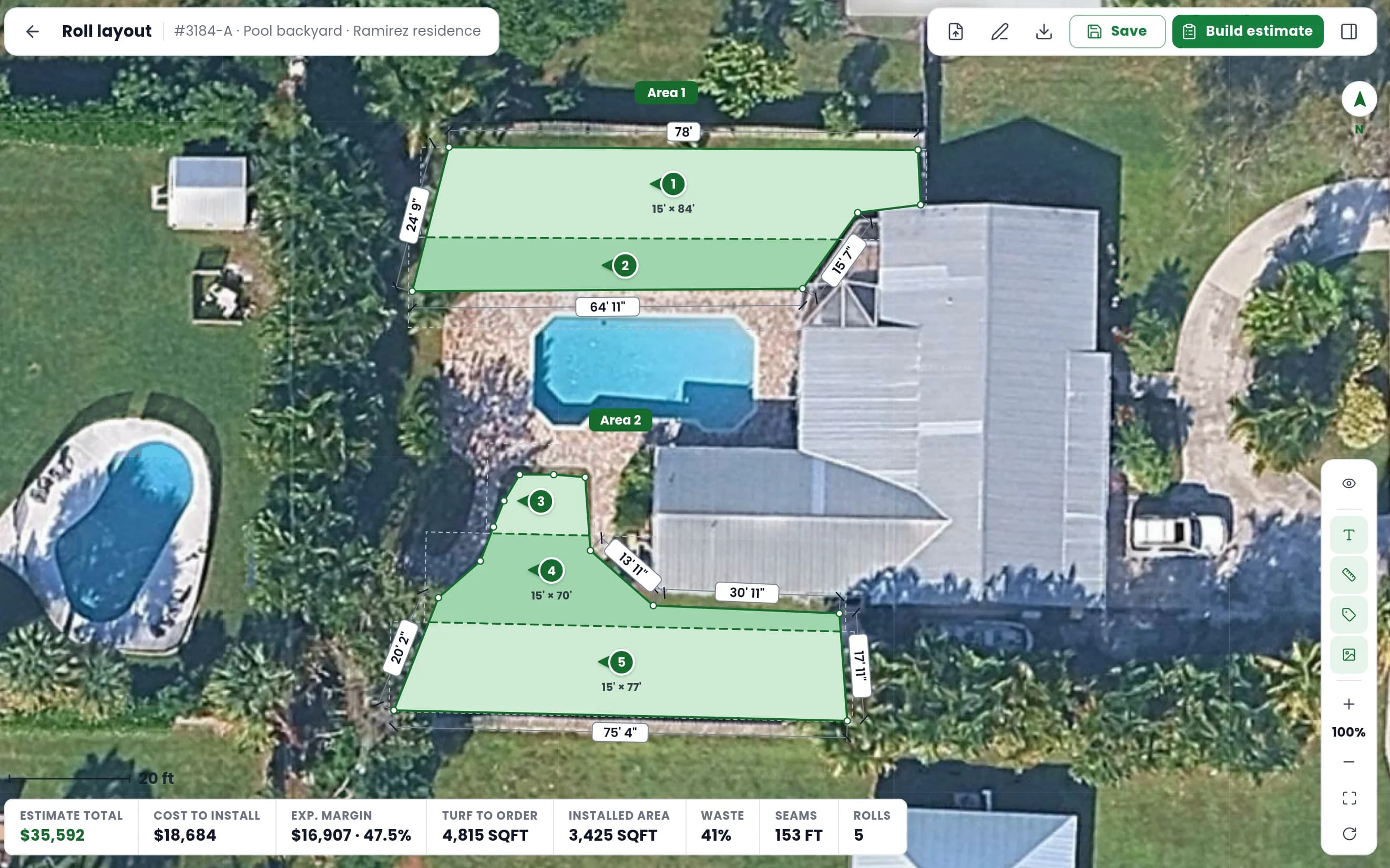
Order by the roll, not by the sqft. Turf comes in standard rolls, 15 ft wide and 100 ft long, so what you order is the number of widths it takes to cover the yard, times the cut length of each piece, plus a little for trimming. The yard's square footage is only the starting point.
On a clean rectangle that usually lands a few percent over the measured area. On a yard full of curves and planter beds it is common to order 15 to 20 percent more than you install. Roll direction is the biggest lever you have, and you pull it before you order, not on site.
Key takeaways
- Order in whole roll widths times cut length, never straight off the measured sqft.
- Turf rolls are 15 ft wide and 100 ft long. Lay out to the usable width after trimming the factory edge.
- Try the layout both ways. The same yard can swing 10 percent or more in waste on direction alone.
- Clean rectangles typically waste 3 to 8 percent, curvy yards 12 to 20 percent or more.
- Keep the pile running one way on every piece, including fill pieces cut from leftovers.
Why square footage is not what you order
A homeowner says the yard is 1,200 sqft. That number tells you what gets covered. It does not tell you what you have to buy, because the distributor does not sell 1,200 sqft. They sell a piece of a roll that is a fixed width, cut to a length you choose.
So every yard turns into a stack of strips. Each strip is one roll width wide and as long as the yard runs in that direction, plus trim. Anything a strip covers past the edge of the yard is waste, and you pay for it the same as the turf that goes down.
That is why two estimators can measure the same yard and still order different amounts. Your order is built from four numbers:
- Widths: the yard's size across the rolls, divided by the usable roll width, rounded up.
- Cut length: the yard's size in the roll direction, plus trim at each end.
- Linear feet: widths times cut length. This is what your distributor cuts.
- Ordered sqft: linear feet times roll width. This is what you pay for.
Artificial turf roll sizes: widths and lengths
Turf ships in standard rolls, 15 ft wide and 100 ft long, from landscape and pet turf to putting greens. The width is the number that drives your layout, so plan every job around 15 ft strips.
Roll length is less of a limit. A full roll is 100 ft, and most distributors cut to length, so you order the linear feet you need rather than whole rolls. If one piece has to be longer than a full roll, you add an end seam across it, which you want to keep out of anywhere people look.
Watch the usable width. A 15 ft roll has a factory edge on each side that you trim off before seaming, usually one or two stitch rows. Two 15 ft widths seamed together cover a little less than 30 ft. If the yard is exactly 30 ft across, two widths can come up short. Measure the usable width on the product you are using and lay out to that number.
Tip: Lay out with the usable width, not the label width. Coming up an inch short at a fence line costs you a whole extra cut.
Roll direction, pile direction and rounding to whole widths
Turf has a grain. The blades lean one way, and the same turf looks a shade lighter or darker depending on which side you look from. Every piece in a lawn has to run the same direction, or the seams show as two colors even when they are tight.
Most installers point the grain toward the main viewing spot, usually the back door or patio, so the lawn looks full from where the customer stands. Decide it up front, because grain locks in roll direction, and roll direction decides how many widths you buy.
Roll direction also decides where seams go. Side seams run the length of the rolls. Turn the rolls 90 degrees and you change the number of seams, their length and where they land. A layout that is cheap on material can put a seam right down the walk to the gate, so look at both before you commit.
Rounding up to whole widths is where most waste comes from. If the yard is 31 ft across the rolls, you need three 15 ft widths, and the third one does 1 ft of work for its whole length. Either turn the rolls, or fill that strip from a leftover with the grain matched.
Typical turf waste factor by yard shape
Waste factor is the ordered sqft minus the installed sqft, as a percentage of the installed sqft. There is no single right number. It depends on the shape of the yard, the roll width and how well the layout fits. These ranges are typical for residential work:
| Yard shape | Typical waste | Why |
|---|---|---|
| Rectangle that fits the roll width well | 3 to 8% | Mostly end trim |
| Rectangle that misses the roll width | 10 to 20% | A partial width runs the full length |
| L-shape or a side run | 8 to 15% | The second area may need its own pieces |
| Curvy beds, round edges, planters | 12 to 20% | Every curve leaves offcuts |
| Many small areas or cutouts | 15 to 25% or more | Small pieces and lots of trim |
Treat these as a sanity check, not a number to multiply by. A flat 10 percent overbuys on clean yards and runs short on curvy ones. Lay out the rolls and let the layout tell you.
Worked example: one yard, two roll directions
Say a made-up backyard is 52 ft along the back of the house and 28 ft deep, a plain 1,456 sqft rectangle. The turf comes in 15 ft rolls. Add 1 ft to each cut for trim, 6 inches at each end.
Direction A runs the rolls along the house, 52 ft long. The yard is 28 ft deep, so two widths cover it. Two pieces at 53 ft is 106 linear ft.
Direction B runs the rolls away from the house, 28 ft long. The yard is 52 ft wide and three widths only cover 45 ft, so you need four. Four pieces at 29 ft is 116 linear ft.
| Direction A | Direction B | |
|---|---|---|
| Rolls run | Along the house, 52 ft | Away from the house, 28 ft |
| Widths | 2 | 4 |
| Linear ft with trim | 106 | 116 |
| Ordered sqft | 1,590 | 1,740 |
| Waste | 134 sqft, about 9% | 284 sqft, about 20% |
| Seams | 1 seam, 52 ft | 3 seams, 84 ft total |
| Biggest leftover | 2 ft x 53 ft strip | 8 ft x 29 ft piece |
On material and seams, A wins easily: 150 sqft less turf and two fewer seams. The case for B is grain. Running the rolls along the house means the grain runs sideways to the patio instead of toward it. On most products that is fine. On a product with a strong color shift, it may be worth the extra turf. Make that call on purpose, with the numbers in front of you.
B also leaves an 8 ft by 29 ft piece. If the job has a side yard, that piece may cover it, and the real waste on B drops a lot.
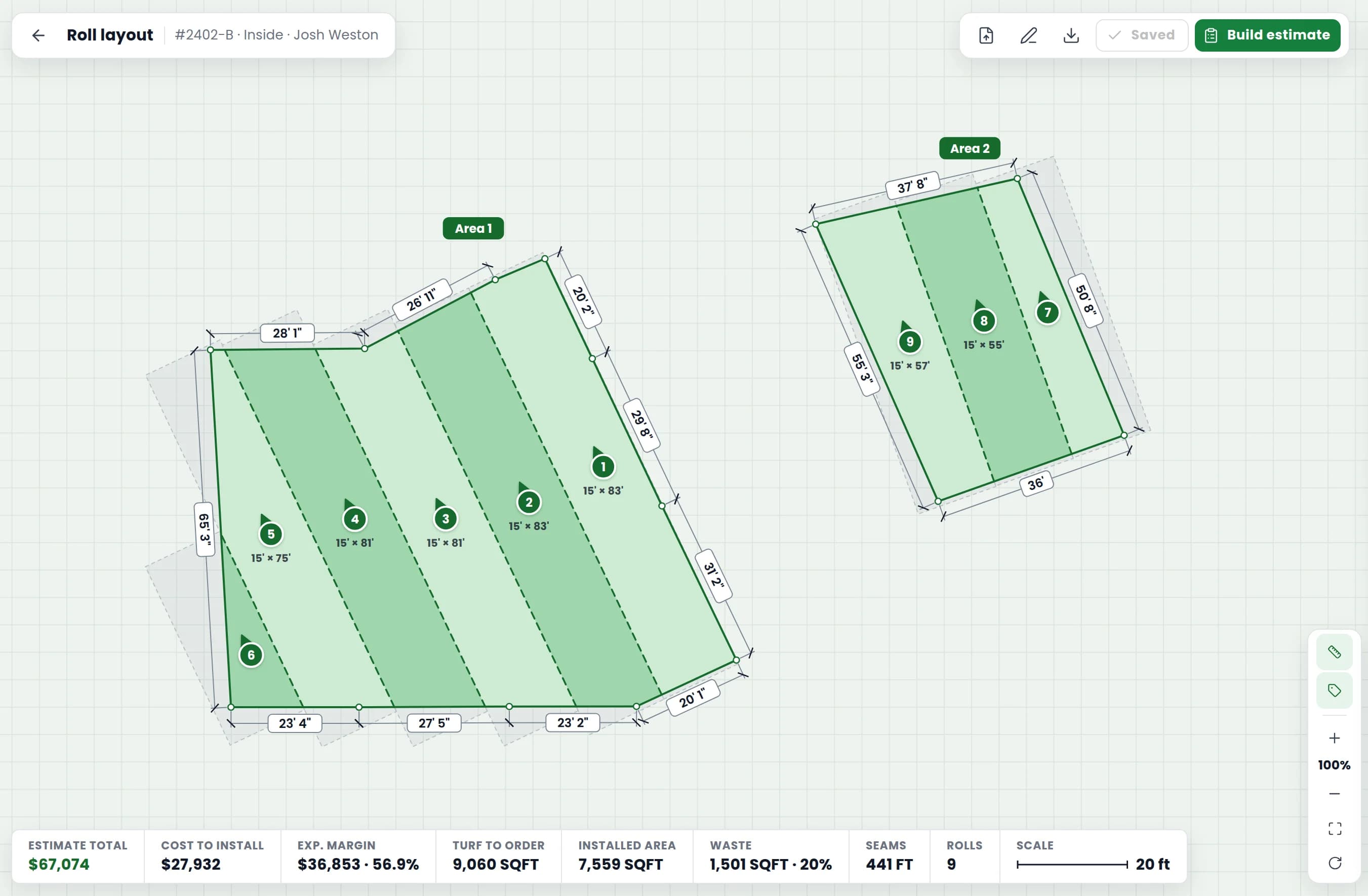
TurfEstimator's roll layout runs this comparison for you from a satellite measurement, a DXF or CSV from CAD or a Moasure, a picture or a drawing. It finds the best roll direction, numbers every roll, marks the seams and shows the waste next to the estimate, cost and margin, so the turf you order is the turf on the estimate.
Cut-offs you can reuse
Not every leftover is waste. A piece is worth keeping when it is big enough to cover something on this job, and you can lay it with the grain running the same way as the area around it.
- Side yards and narrow runs: a 3 to 5 ft strip off the edge of a width often covers a side yard on its own.
- Fill pieces: when a yard runs a couple of feet past a whole width, a strip from a leftover can fill it instead of a full new width. It adds a seam, so keep it out of sight lines.
- Around pavers and stepping stones: small, odd-shaped spots use up offcuts that would otherwise go in the dumpster.
- Dog runs and utility areas: places where looks matter less are the best home for pieced-together leftovers.
Plan reuse before you order, not after the crew finishes. If the cut list already says the leftover from roll 4 covers the side yard, you buy less turf.
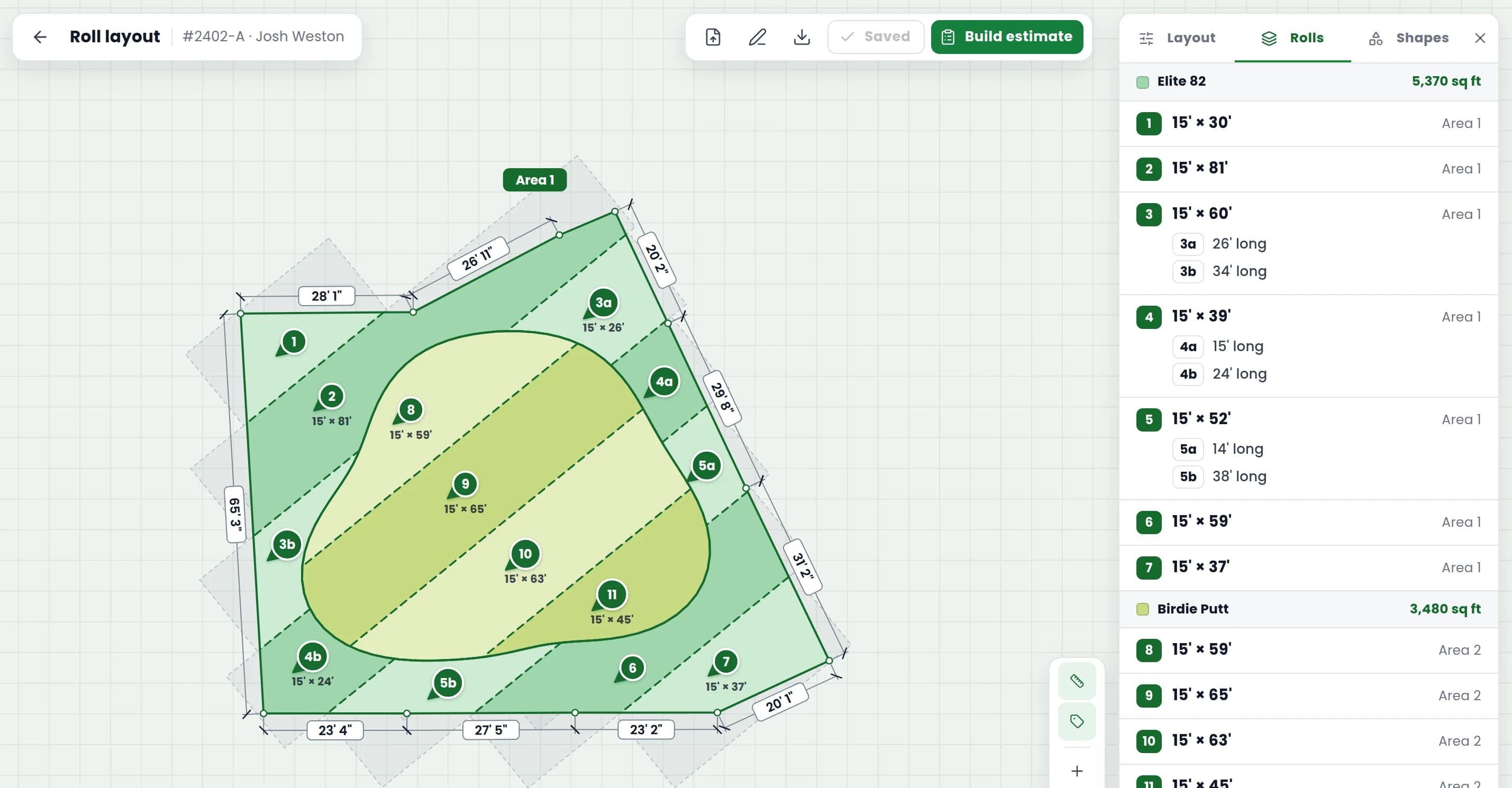
TurfEstimator lists every roll and every piece cut from it, so the crew knows which piece goes where and which offcut to save for the side yard.
Order a little extra, or order tight?
Order tight on material and careful on measurements. A short order usually costs more than a little waste: a second delivery charge, a lost half day, and sometimes a production run whose color does not quite match.
- Confirm the measurement on site before ordering if it came from a satellite image or from the homeowner.
- Lay out the rolls both directions, using the usable width of the actual product.
- Pick the direction on grain first, then on waste and where the seams land.
- Add trim to each cut, usually around 6 inches per end, more on slopes or uneven edges.
- Order the linear feet the layout calls for. If one measurement is uncertain, add a few feet to that one cut, not a percentage to the whole order.
- Order everything for one lawn from the same production run so the color matches.
The habit that saves the most money is not a bigger safety margin. It is laying out every job in rolls before you price it. When the estimate is built from the layout, the turf, seam tape and nails on the quote match what you order, and the margin you saw before sending is the margin you keep.
Questions installers ask
How do I calculate how much artificial turf to order?
Divide the yard's size across the rolls by the usable roll width and round up to get the number of widths. Multiply that by the cut length in the roll direction, plus trim, to get linear feet. Multiply linear feet by the roll width for the sqft you pay for, and run it both directions to see which is better.
What sizes do artificial turf rolls come in?
Standard turf rolls are 15 ft wide and 100 ft long, and most distributors cut to length, so you order the linear feet each piece needs.
What waste factor should I use for artificial turf?
Typical ranges run about 3 to 8 percent on clean rectangles and 12 to 20 percent or more on curvy yards with beds and cutouts. A flat percentage is only a rough check. Laying out the actual rolls gives you the real number for that yard.
Should I order extra turf just in case?
Order what the layout calls for, plus a few extra feet on a single cut where a measurement is uncertain. Running short is usually worse than a small overage, because a second order can mean another delivery fee and a color mismatch from a different production run.
Does roll direction really change the order?
Yes. Direction sets how many widths you buy, how long each cut is and where the seams land.