
Guides / Leads
How to get more artificial turf leads that actually sign
More leads is easy. More leads that book and sign is the real job. Here is what works for turf installers, from your own website to builder referrals.
By Josh West, co-founder of TurfEstimator | October 22, 2026 | 8 min read
The fastest way to get more artificial turf leads that turn into jobs is to stop treating every form fill the same. Show homeowners a real price range on your own website, get found on Google with reviews and local pages, track which sources actually sign, and follow up fast and automatically, including with the people who started a quote and stopped.
Most turf companies do not have a lead count problem. They have a problem with leads that waste a site visit, leads nobody calls back for two days, and ad money going to sources that never close. Fix those and the same marketing budget books more jobs.
Key takeaways
- A plain contact form attracts price-shoppers. A price range up front filters them before the site visit.
- Google Business Profile reviews and real job photos do more for local turf searches than almost anything else you can do for free.
- Track leads all the way to signed jobs by source, not just clicks and form fills.
- Call or text back fast, and let automatic follow-ups catch the ones you miss.
- People who started your quote form and stopped are warm leads. Go get them.
Why a plain contact form brings tire kickers
A "Get a free quote" form with name, email and phone asks for nothing and tells the homeowner nothing. So everyone fills it out: the person ready to sign this month, the person curious what turf costs, and the person who saw a $2 a sqft ad from a big box store and thinks that includes install.
You find out which one you have after you drive out, measure, and spend an hour at the kitchen table. Multiply that by every lead in a busy spring and the cost of a bad lead is not the ad, it is your Saturday.
The fix is not fewer leads. It is giving homeowners enough information up front that the ones who were never going to buy at your price sort themselves out, and the ones who are ready show up already expecting your number.
Put a price range on your own website
Homeowners want a number before they talk to anyone. If your site will not give them one, they keep looking until a site does. A quote form that shows a price range answers the question they came with and keeps them on your site.
A good turf quote form does a few things:
- Lets the homeowner measure the yard themselves, for example by tracing it on a satellite map.
- Asks your questions: pets, putting green, current surface, access through the side yard, timeline.
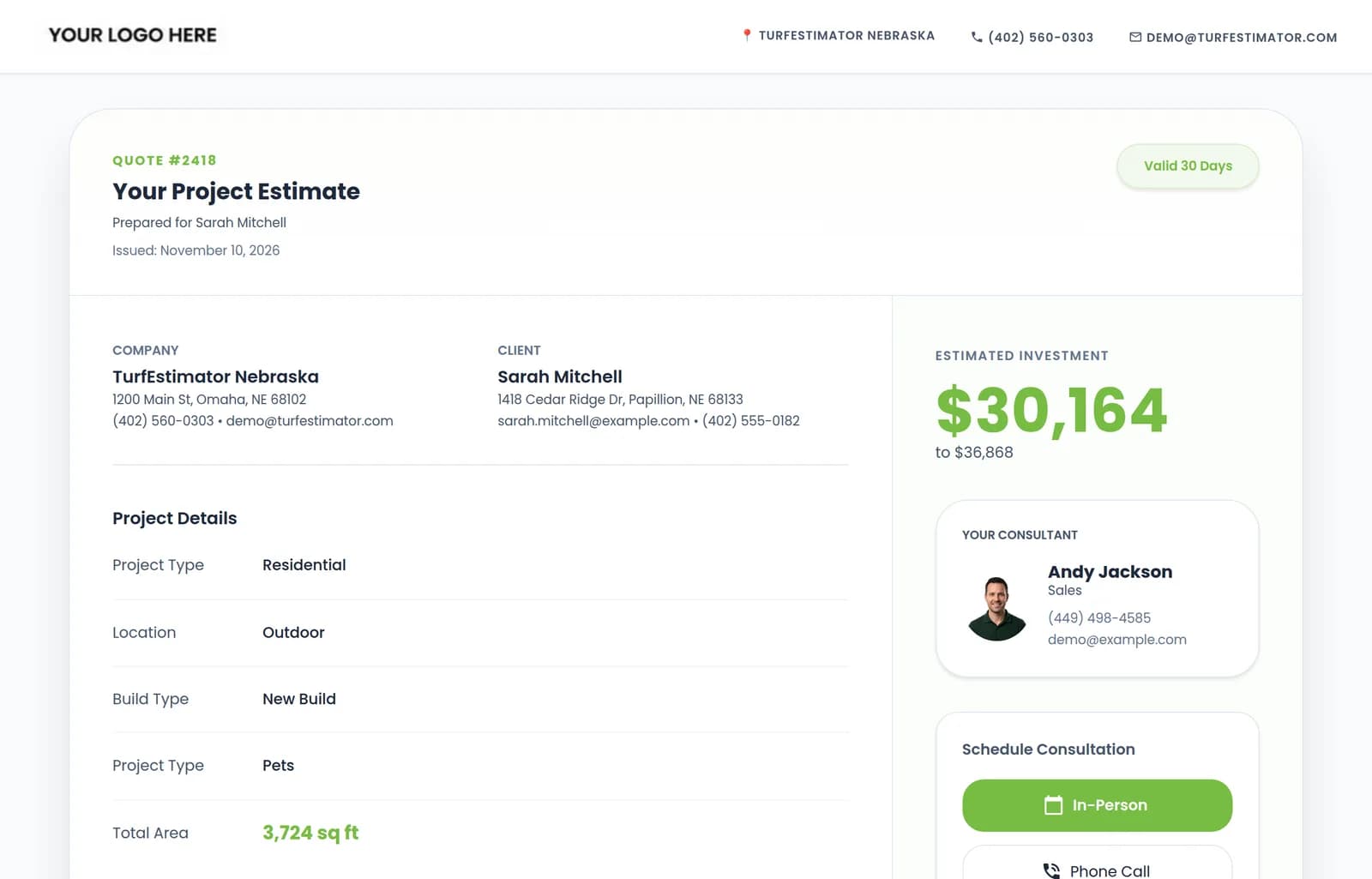
- Shows a price range from your own pricing, wide enough to be honest about what a satellite photo cannot show.
- Ends with booking a consultation, so the next step is a calendar slot, not a phone tag.
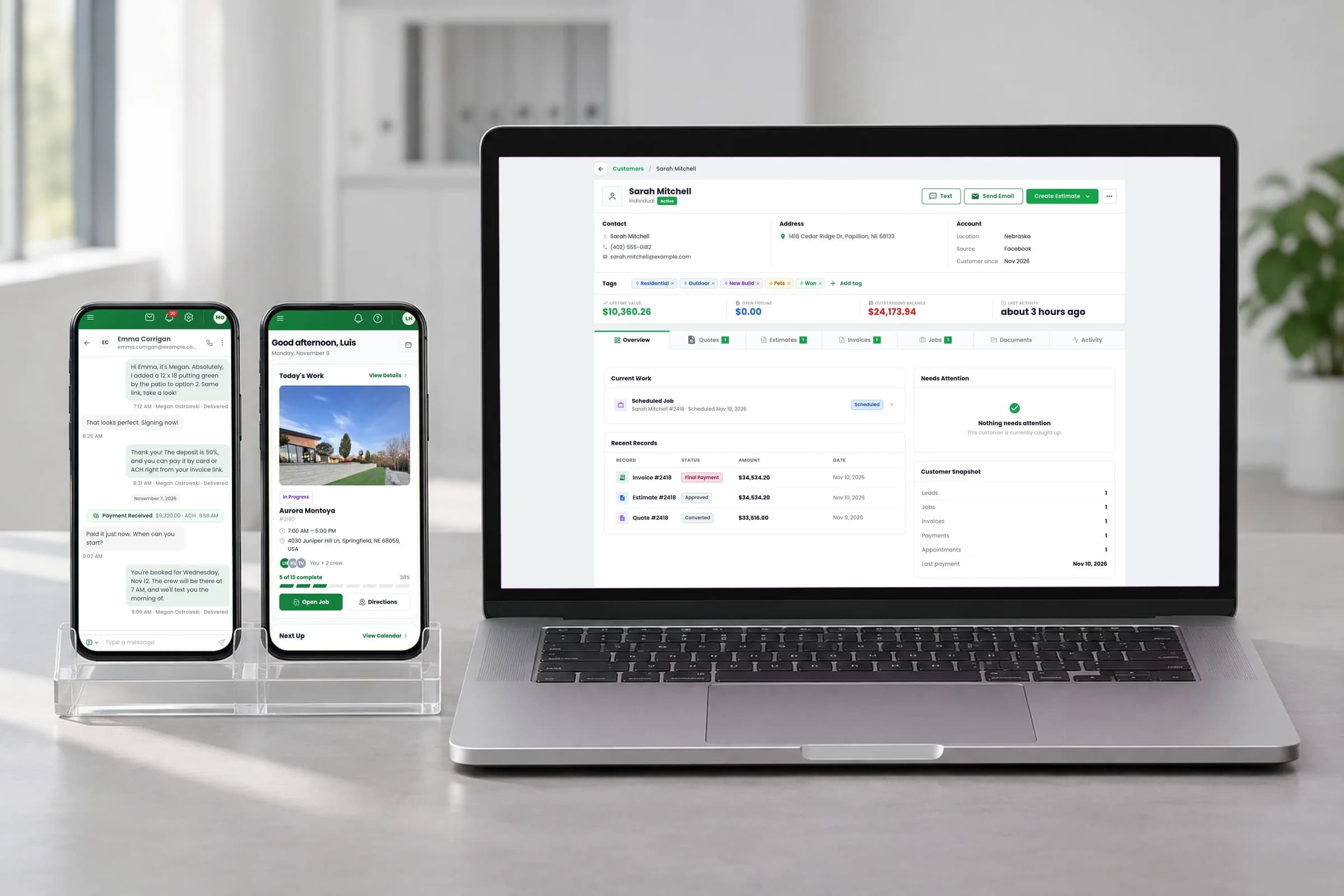
TurfEstimator's instant quote form does this on your own site, whether it runs on WordPress, Wix, Squarespace or GoDaddy, or as a link you share. Homeowners trace the yard, answer your questions, see a range from your pricing engine and book.
Tip: Put the quote form on every page, not just a Contact page. The homeowner reading your pet turf page is the one most ready to price their yard.
Google Business Profile, reviews and job photos
When a homeowner searches "artificial turf installers near me", the map results come first, and the map is run by your Google Business Profile. Treat it like a second website.
- Pick the right primary category and add your services: artificial turf installation, putting greens, pet turf, synthetic grass repair.
- List the cities you really serve as your service area.
- Post photos every week from real jobs: before, during and after. Wide shots of the finished yard, close-ups of seams you are proud of, the dog on the new turf.
- Answer every review, good or bad, in a sentence or two that sounds like a person.
Reviews are the part most installers let slide. The best time to ask is the day the job is finished, when the yard looks perfect and the homeowner is happy. Send the review link by text that day, and send a reminder a few days later if they have not left one. Automatic review requests in TurfEstimator go out when the job is done, so nobody has to remember.
Use the same job photos everywhere: the profile, your website, social posts and your estimates. A homeowner trusts a yard in their own town more than any stock photo.
Local service pages that match how people search
Homeowners search for a service in a place: "pet turf Mesa", "putting green installer Frisco", "artificial grass Henderson". One generic Services page cannot rank for all of those.
Build a page for each main service (backyard turf, pet turf, putting greens, commercial) and a page for each city or area you want work in. Make each one worth reading on its own:
- Photos and a short write-up of real jobs in that area.
- What is different about installing there: soil, heat, HOA rules, water restrictions.
- What a typical job includes and what changes the price.
- The quote form, right on the page.
Do not copy one page and swap the city name. Pages like that tend to get ignored by search engines and by homeowners. Five real pages beat fifty thin ones.
Paid ads: track which sources sign, not which ones click
Google Ads, Local Services Ads, Facebook and Instagram, lead marketplaces: they can all bring artificial turf leads. The question is which ones bring jobs. Clicks and form fills look great in an ad dashboard and say nothing about whether those people signed.
Track every lead from its source to the end: booked a consultation, got an estimate, signed, paid. A month of numbers like this made-up example tells you more than a year of click reports:
| Source | Leads | Consults booked | Signed | Revenue |
|---|---|---|---|---|
| Google search ads | 40 | 18 | 6 | $54,000 |
| Facebook ads | 65 | 12 | 2 | $15,000 |
| Google Business Profile | 22 | 14 | 7 | $68,000 |
| Referrals | 9 | 8 | 5 | $47,000 |
In that example the source with the most leads signed the fewest jobs. Without tracking to the signature, you would put more money into it.
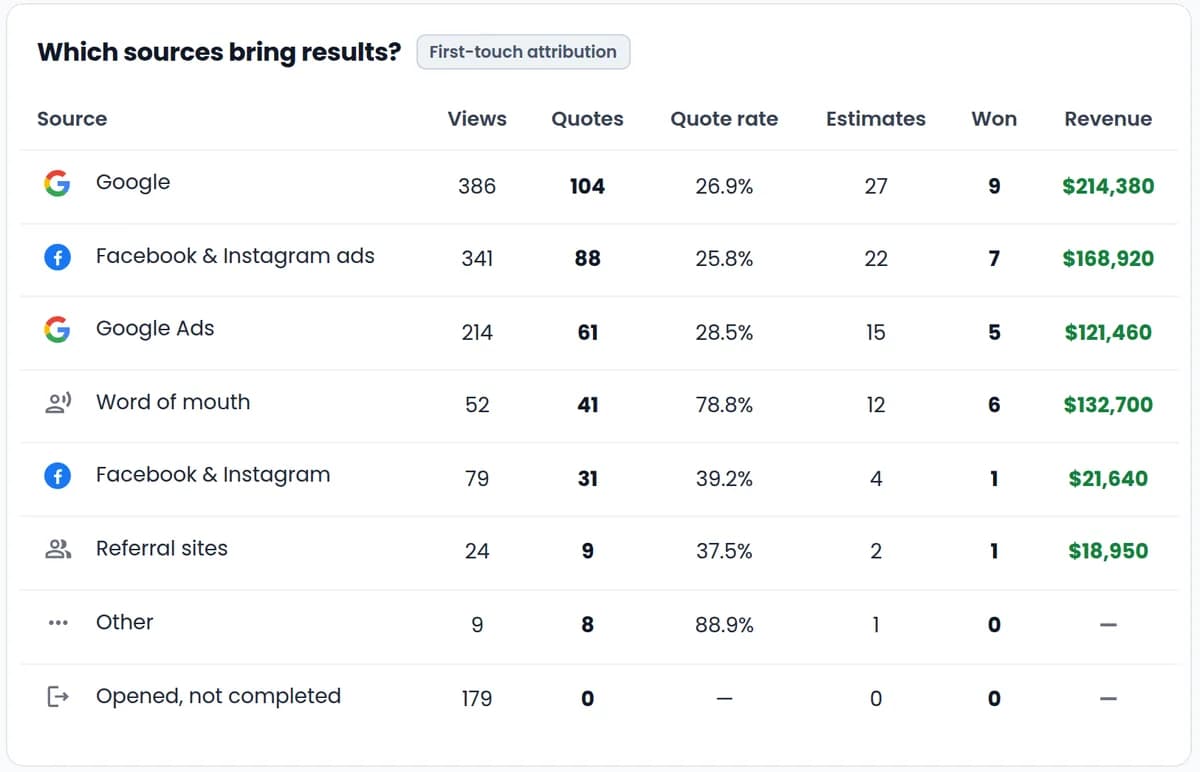
TurfEstimator tags leads by source, tracks paid ad clicks through to the lead, and has reports for lead sources and revenue by source, so you can see which ads pay for themselves. Also keep asking "how did you hear about us" on the form. What the homeowner says and where the click came from are two different answers, and both are useful.
Follow up fast, automatically, and catch the ones who stopped
Turf shoppers usually ask more than one installer. The one who answers first, while the homeowner is still thinking about their yard, gets the first conversation and often the job. A lead that waits until tomorrow has already talked to someone else.
You cannot answer every lead in five minutes from a job site. So set up follow-up that runs without you:
- Text and email right away when a lead comes in, from your business number, with a link to book a time.
- Remind them the day before the consultation so they are home when you show up.
- After you send an estimate, follow up a couple of days later if they have not signed, then again a week later.
- Keep texts and emails in one thread per customer, so whoever picks up the conversation sees everything that was said.
Then go after partial leads. These are homeowners who started your quote form and stopped, maybe at the measuring step, maybe at the contact step. They were interested enough to start pricing their yard. If they left a phone number or email before they stopped, a short, friendly message ("Saw you started a quote for your backyard, want me to finish it for you?") brings a lot of them back.
Look at where people stop, too. If most drop off at the same step, that step is asking too much, too early.
Referrals and builder relationships
Your best leads come from people who have already seen your work. A happy customer's neighbor has looked over the fence at your seams for six months. Make it easy to send them your way:
- Ask for referrals at the same time you ask for the review, while the yard is new.
- Leave a yard sign up for a week or two after the install, if the homeowner is fine with it.
- Give something real for a referral that signs: a credit on their next project or a gift card.
Then work the trades that see turf customers before you do: home builders, pool builders, landscape designers, hardscape and paver companies, property managers and HOA boards. A pool builder finishing a backyard needs someone to put turf around the deck, and a builder with a dozen spec homes needs one installer who shows up on schedule.
Win those relationships the boring way. Answer fast, give them clean estimates they can pass to their client, show up when you said, and send photos of the finished job they can use in their own marketing. One builder who trusts you can be worth more than any ad you run.
Questions installers ask
Where do turf installers get the best leads?
For most installers the best leads come from Google (the map listing and search), referrals from past customers, and relationships with builders and other trades. Paid ads can work well too, but only if you track which campaigns actually produce signed jobs, not just form fills.
Should I buy artificial turf leads from lead marketplaces?
You can, but treat them like any other paid source. These leads are often sent to several installers at once, so speed matters even more. Track how many signed and what you earned against what you paid, and drop the source if it does not pay for itself.
How do I stop wasting time on tire kickers?
Give homeowners a realistic price range before the site visit, for example with a quote form on your website that measures the yard and runs your pricing. People who were expecting a much lower number sort themselves out, and the ones who book already know roughly what it costs.
How fast should I respond to a turf lead?
As fast as you can, ideally within minutes. Homeowners usually contact more than one installer, and the first one to answer gets the first conversation. An automatic text and email the moment the lead comes in buys you time until you can call.
What is a partial lead?
A partial lead is someone who started your quote form and stopped before finishing. If they left contact information before they stopped, follow up with a short, friendly message. They already showed interest in pricing their yard, so many of them are worth a second try.