
Guides / Pricing
How to price artificial turf installation so every job makes money
Build your price from your real cost per sqft, add a margin you chose on purpose, and cover the jobs that cost more than they look. A worked example included.
By Josh West, co-founder of TurfEstimator | October 29, 2026 | 9 min read
To price artificial turf installation, add up what the job really costs you (turf and materials sized from the layout, labor hours, equipment, haul-away and a share of overhead), then divide by one minus the margin you want to keep. That gives you a job price. Divide it by the square footage and you have your artificial turf installation price per square foot for that kind of job.
The hard part is knowing your real numbers, catching the jobs that cost more than they look, and making sure the quote you send still has the margin you meant. Below is each piece, with a made-up example job you can redo with your own costs.
Key takeaways
- Price from your own cost per sqft, not from what the guy down the road charges.
- Margin and markup are not the same number. A 35% markup is only about a 26% margin.
- Set a minimum job charge so small jobs still pay for the trip, the trailer and the crew day.
- Charge adders for no machine access, slopes and demo instead of hiding them in a flat rate.
- Check the margin on the final quote, after options and discounts, before you hit send.
Know your real cost per sqft first
If you do not know what a job costs you, any price is a guess, and guesses on turf jobs come in low because the expensive surprises (waste, haul-away, an extra day) get left out.
Break your cost into these buckets:
- Turf: the square footage you actually order, not the square footage of the yard. Rolls are 15 ft wide, so the roll layout decides how much you buy and how much ends up as waste.
- Materials: crushed base (typically 3 to 4 inches), weed barrier, seam tape and glue, nails or staples, edging or nail board, and infill. Infill in pounds per sqft depends on the turf, so follow the manufacturer's spec.
- Labor: crew hours times your loaded hourly cost, meaning wages plus payroll taxes, workers comp and any benefits. Count the drive time too.
- Equipment: skid steer or mini loader, plate compactor, sod cutter, power broom. Use the rental rate, or a fair hourly rate on gear you own so it pays for its replacement.
- Haul-away: dump fees and trucking for the dirt and sod you dig out. A 3 inch dig over a big yard is a lot of loads.
- Overhead: insurance, trucks, phones, software, office help and your own time selling. Divide last year's overhead by the number of jobs you did to get a per-job share.
Tip: Pull your last five finished jobs and compare what you quoted to what they actually cost. The gap tells you which bucket you keep underestimating.
A worked example: one backyard, start to finish
Say a 1,000 sqft backyard with good machine access, a flat yard and no demo beyond sod removal. Every number below is a made-up example to show the math, not a market price. Your supplier, crew and dump costs set yours.
| Cost line | How it was figured | Example cost |
|---|---|---|
| Turf | 1,120 sqft ordered (12% waste) at $2.50 | $2,800 |
| Base and weed barrier | About 3 inches of base, delivered | $600 |
| Infill | 2 lb per sqft per spec, 40 bags | $400 |
| Seam tape, glue, nails, edging | From the seams and perimeter | $250 |
| Labor | 3 people, 2 days, 54 hours at $30 loaded | $1,620 |
| Equipment | Mini loader, compactor, sod cutter | $450 |
| Haul-away | Dump fees and trucking | $400 |
| Overhead share | Last year's overhead divided by jobs | $500 |
| Total cost | $7,020 |
Now pick a margin. At a 35% margin the price is $7,020 divided by 0.65, which is $10,800. That works out to $10.80 per sqft for this job. If the same yard had a long, skinny shape that pushed waste to 20%, the turf line alone would go up by $200, and the per-sqft price you would need climbs with it. That is why the layout comes before the price.
Choosing a margin you can live on
Margin is the share of the price you keep. Markup is what you add on top of cost. They get mixed up all the time, and the mix-up costs money. If you add 35% to $7,020 you get $9,477, and your margin on that job is only about 26%.
To hit a target margin, use this: price equals cost divided by one minus the margin. For 30% that is cost divided by 0.70. For 40% it is cost divided by 0.60.
There is no single right margin. It depends on whether overhead is already in your cost (like the example above), how busy you are and how much risk the job carries. A few rules that hold up:
- Pick the margin on purpose and write it down, so every estimator in the company prices the same way.
- Use a higher margin on jobs with more unknowns: old concrete, tight access, a homeowner who keeps changing the plan.
- Do not drop margin to win a job you would have won anyway. Drop scope instead, like a less expensive turf.
Price per sqft vs job pricing, and the minimum charge
Homeowners think in price per square foot, so you need a per-sqft number to talk about. But the price you send should come from the job cost, because a lot of your cost does not scale with square footage. Loading the trailer, delivering equipment, setting up and cleaning up cost about the same for a 300 sqft side yard as for a 1,500 sqft backyard.
A practical way to handle it is per-sqft pricing in size bands. Small jobs carry a higher rate per sqft, big open yards a lower one, and each band is built from a real example job like the one above.
Then set a minimum job charge. Work out what one crew day costs you with equipment, travel, materials for a small area and your overhead share, add your margin, and that is your floor. A 150 sqft dog run priced at your big-yard rate will lose money every time. Below the minimum, the price is the minimum.
Tip: Quote the job price, not the per-sqft rate, on the final estimate. A per-sqft number invites the homeowner to shrink the area and expect the price to shrink with it.
Adders for access, slopes and demo
Two yards with the same square footage can cost very different amounts to install. Instead of padding every quote to cover the hard ones, keep a list of adders and charge them when they apply. Price each adder in labor hours, equipment and disposal, the same way you priced the base job.
- No machine access: a 36 inch gate or a side yard full of AC units means hand digging and wheelbarrowing base in and dirt out. That can double the labor on the dig.
- Slopes: more base, more compaction, more cutting and sometimes a small retaining edge. Steep grades also slow the crew down.
- Demo: concrete, pavers, old turf, stumps and roots. Concrete especially, because breaking and hauling it adds equipment and heavy dump loads.
- Drainage and irrigation: capping sprinkler heads, rerouting lines or adding drainage under pet areas.
- Distance: long drives cost crew hours. Add a travel charge past a set radius.
Put adders on the estimate as their own lines, so the homeowner sees why their yard costs more than the neighbor's.
Pet turf, putting greens and good, better, best
Price pet areas and putting greens as their own items instead of folding them into the lawn rate.
Pet turf usually means a more expensive product with a flow-through backing, an antimicrobial or cooling infill, and sometimes extra drainage under the base. Those costs are real, and pet owners expect to pay for them. Offer them as a pet option with its own per-sqft price.
Putting greens take more labor per sqft than lawn: shaping and contouring the base, cutting cups, fringe and collar seams, and sand infill brushed in to the right roll. Price greens by the sqft at their own rate, plus each cup, with a minimum. In TurfEstimator, a green and a lawn can go on the same roll layout with different turf types, so both get sized from the real cuts.
Then give every customer three choices. Good, better, best is usually the same labor and base with three turf products, or the same turf with more add-ons on each tier. A lot of homeowners skip the cheapest one once they can see what the next step up gets them, and the tiers give a price-shopper somewhere to go besides asking you to knock money off.
Show a range up front, then check margin before you send
Once your pricing is built, use it early. A homeowner who sees a realistic price range before the consultation either books or bows out, and both are better than a two-hour site visit for someone expecting $3 a sqft. TurfEstimator's instant quote form lets homeowners trace their yard on a satellite map on your own website, answer your questions, and see a range from your pricing engine before they book.
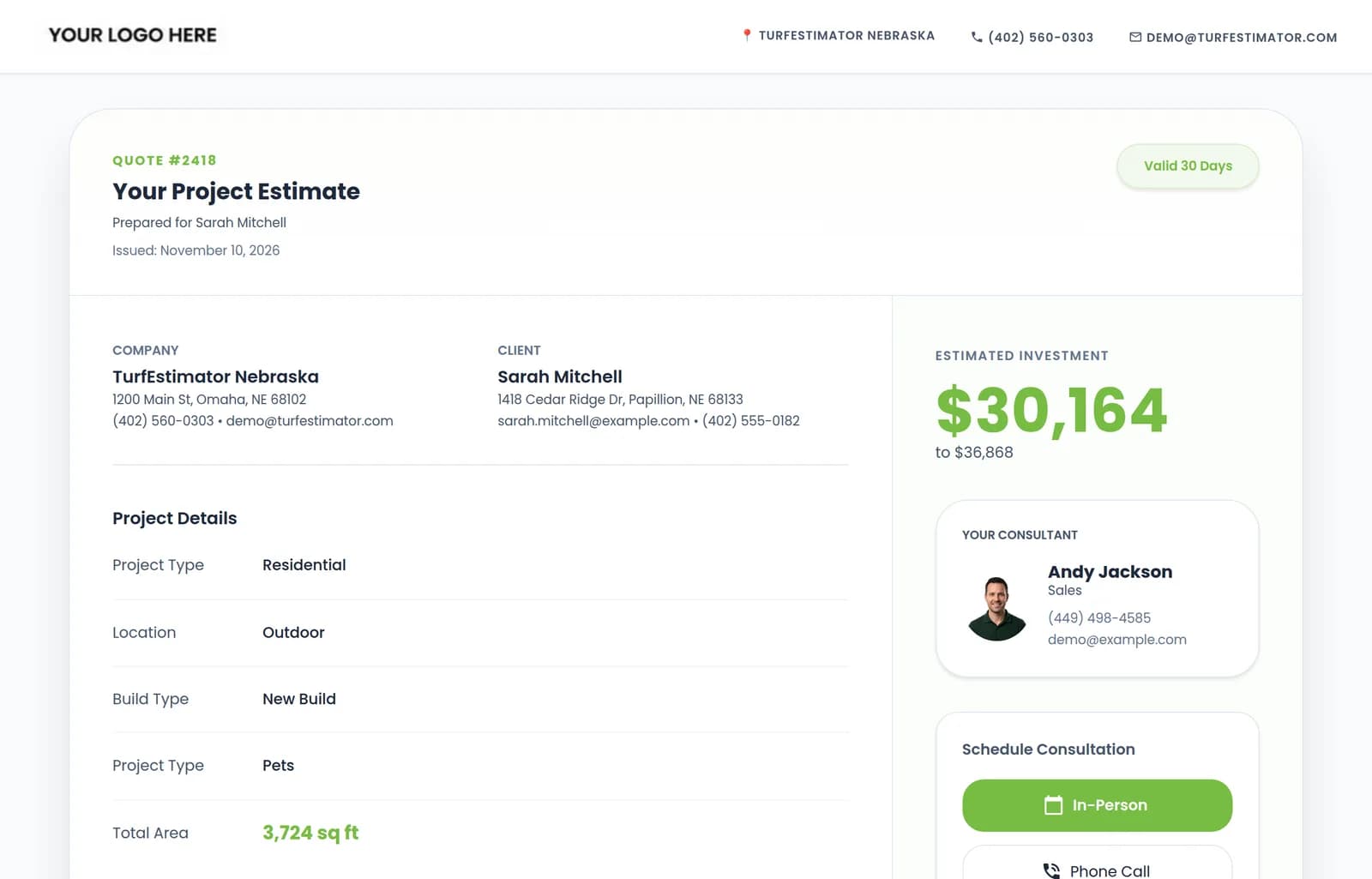
Keep the range wide enough to cover adders you cannot see from a satellite photo, and say the final price comes after the site visit.
Before the final estimate goes out, check the margin on the actual quote, not the one in your head. Waste from the layout, a discount you threw in, an extra add-on, a crew that needs a third day: each one moves the number. Run through this list:
- Size turf, seam tape, edging, base and infill from the roll layout, not from the yard's square footage.
- Confirm labor hours against the access, slope and demo on this yard.
- Add every adder and option the customer picked.
- Look at the total cost and the expected margin after any discount.
- If the margin is under your floor, change the scope or the price before you send, not after the job.
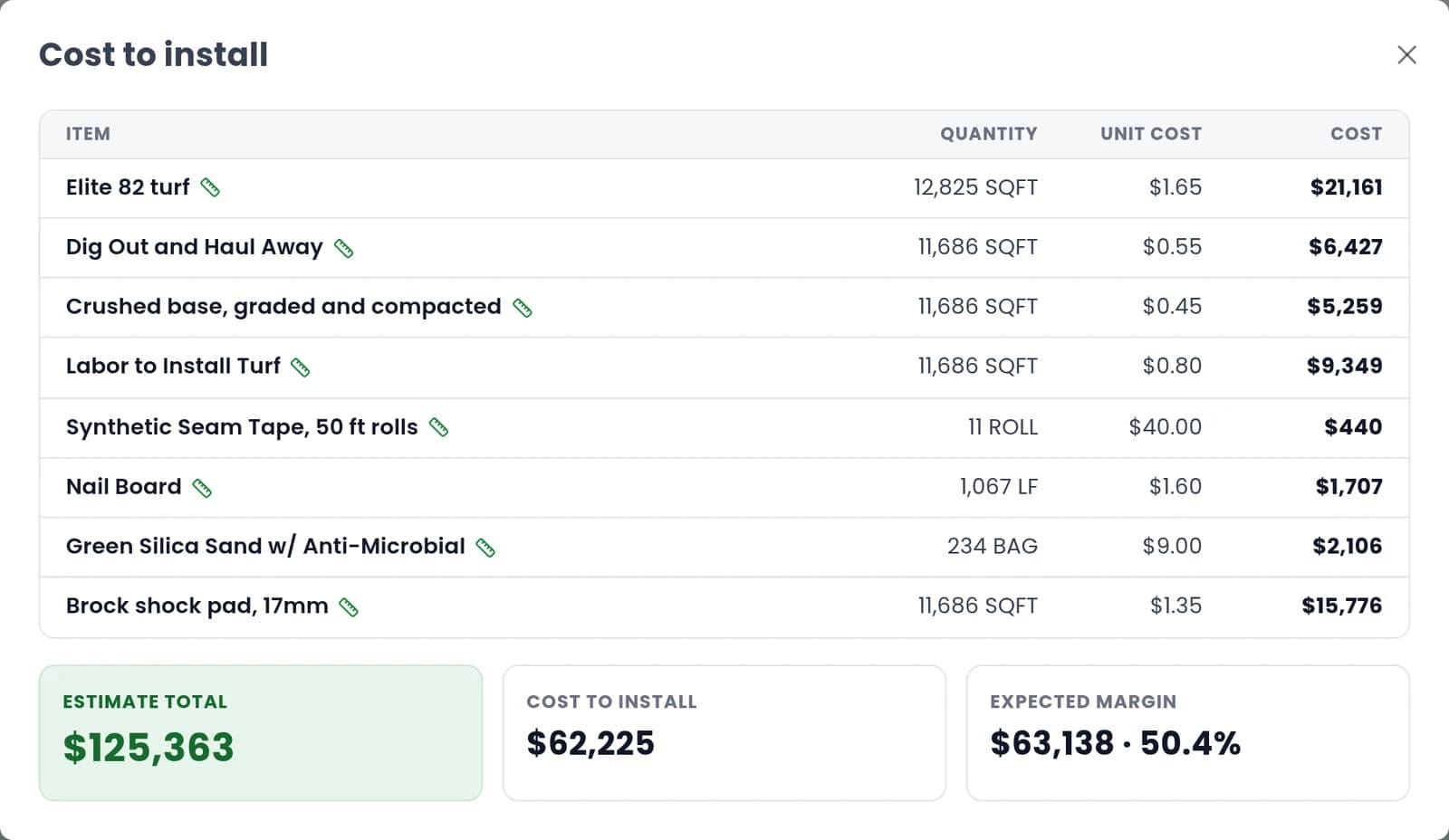
TurfEstimator sizes every product from the roll layout and shows the cost to install and the expected margin on the estimate before you send it, so the check takes seconds instead of a spreadsheet.
Questions installers ask
How much should I charge per square foot to install artificial turf?
Charge your own cost per sqft plus your target margin. Build it from a real job: turf ordered from the layout, materials, labor, equipment, haul-away and overhead, divided by one minus your margin. Keep separate rates for small jobs, big open yards, pet areas and putting greens.
What is a good profit margin for turf installation?
No one number fits every company. It depends on whether overhead is counted in your job cost, the risk on the job and how busy you are. Pick a margin on purpose, price with cost divided by one minus margin, and check it on every quote.
Should I price turf jobs per square foot or by the job?
Use per-sqft rates to give quick ranges and to talk with homeowners, but send a job price built from the real job cost. A lot of your cost, like setup, equipment delivery and the crew day, does not shrink on small jobs. A minimum job charge covers that.
How do I price a turf job with no machine access?
Count the extra labor hours for hand digging and wheelbarrowing base and spoils, plus any smaller equipment you need to rent. Put it on the estimate as its own access line. That way the price makes sense to the homeowner and you are not padding every other quote to cover it.
Should I show prices on my website?
A price range up front saves site visits with people who were never going to buy at your price. Keep it a range wide enough to cover what a satellite view cannot show, and say the final price comes after the visit.