
Guides / Estimating
How to estimate a putting green installation
A putting green is a small job with a lot of work packed into it. Here is how to measure it, price the two turfs, the contours and the labor, and land on a price that pays.
By Josh West, co-founder of TurfEstimator | October 8, 2026 | 8 min read
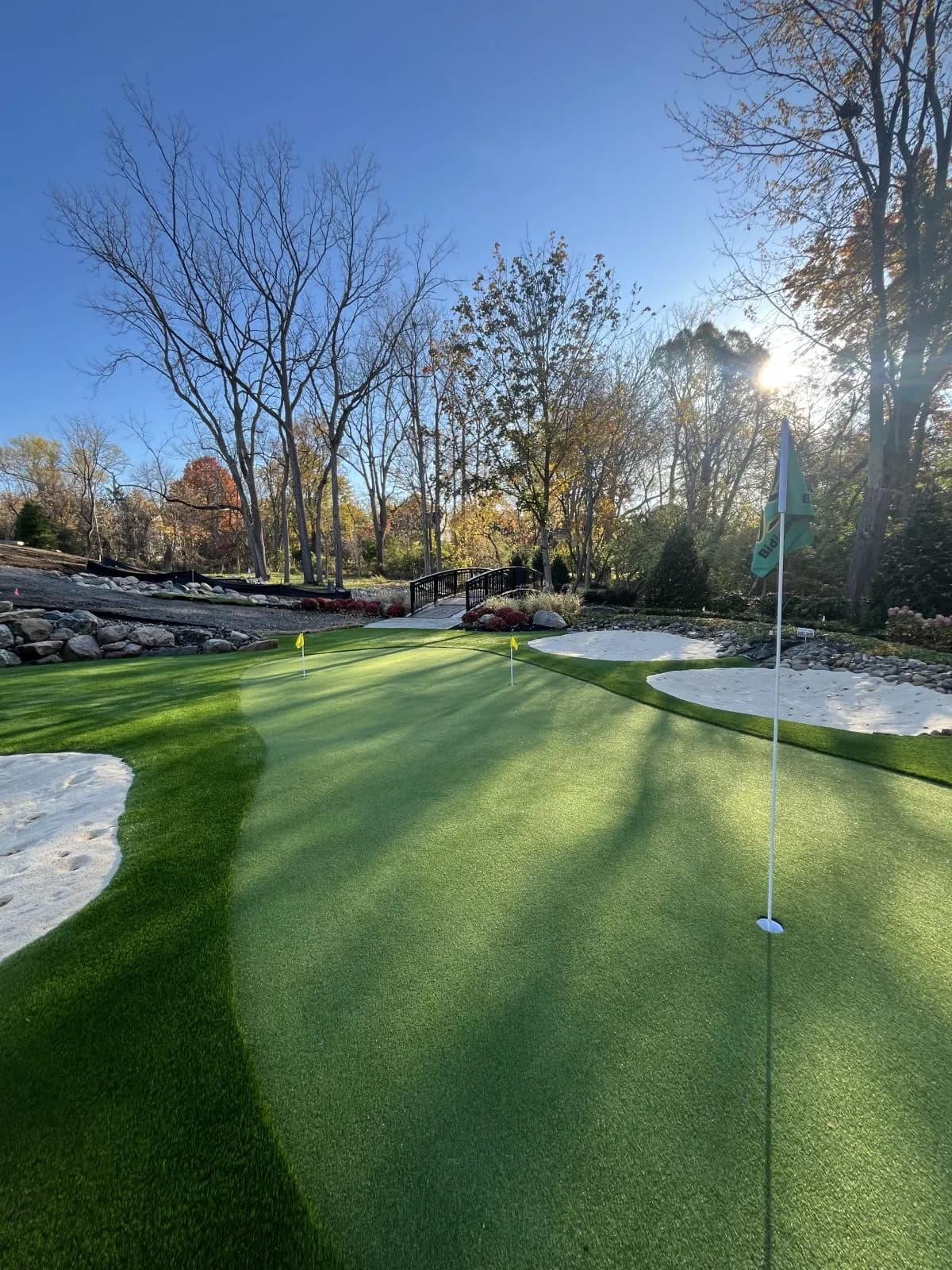
To estimate a putting green, measure the green and the fringe separately, lay out both turfs, then price the cups and flags, the contoured base, the sand infill and the extra labor. Build the price from those line items for the whole job, and only then look at what it works out to per sqft.
Greens lose money when installers price them like a lawn. The area is small, but the shaping, compaction, cutting and seaming take far more time per sqft than a flat backyard.
Key takeaways
- Measure and order the green and the fringe as two separate turfs.
- The joint between green and fringe is a seam around the whole green. Price it.
- Contours mean extra base, extra compaction and extra hours.
- Keep seams out of putting lines, even if it costs more turf.
- Price greens by the job, with a minimum, not by the sqft alone.
Measure the green and the fringe separately
Start with the shape the customer wants. Most backyard greens are kidney or freeform shapes, so a wheel and two numbers will not do it. Stake or paint the outline, then measure it with a laser and offsets, or walk it with a Moasure so the curves come through as a real drawing.
Then measure the fringe. The fringe is the band of longer turf around the putting surface, often 1 to 3 ft wide, and it may blend into a full lawn of turf around the green. Record three things:
- Putting surface area and perimeter. The perimeter is your green-to-fringe seam length.
- Fringe or surrounding lawn area and its outer perimeter.
- Cup locations, high and low points, and where water will drain off the surface.
Tip: Ask how the customer will use it. Chipping from the lawn into the green changes where the cups go and how big the fringe should be.
Putting turf and fringe turf are two different orders
A green uses at least two products: a short, dense putting turf for the surface, and a taller fringe or lawn turf around it. Each has its own price per sqft, its own roll widths, and often its own infill spec. They do not share rolls, so each gets its own layout and its own waste.
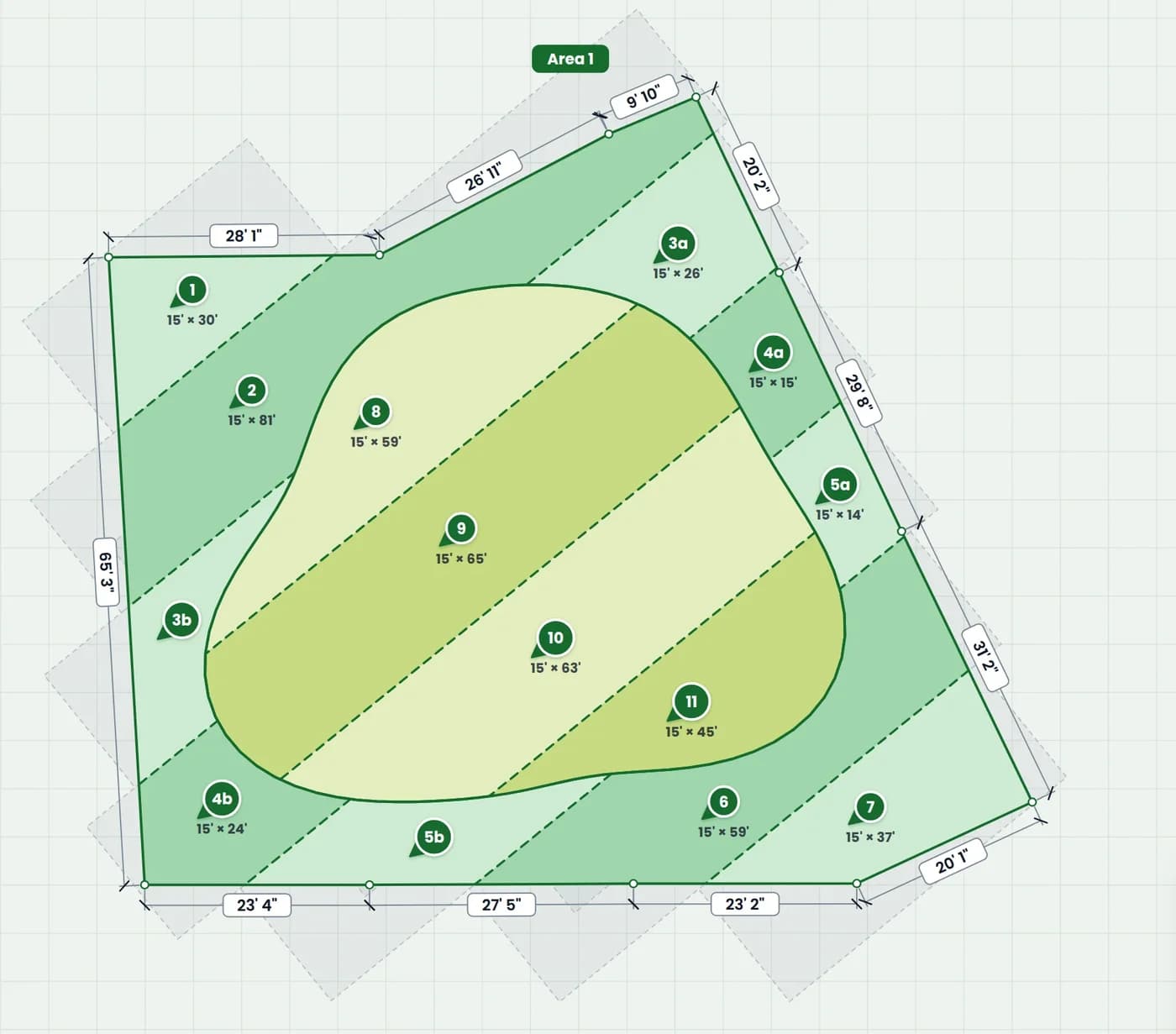
Putting turf comes in 15 ft wide rolls, like the rest of your turf. Many backyard greens fit inside one roll width, which means the putting surface needs no seam at all. Check that before anything else. A green that is 16 ft across forces a seam that a 14 ft green would not have.
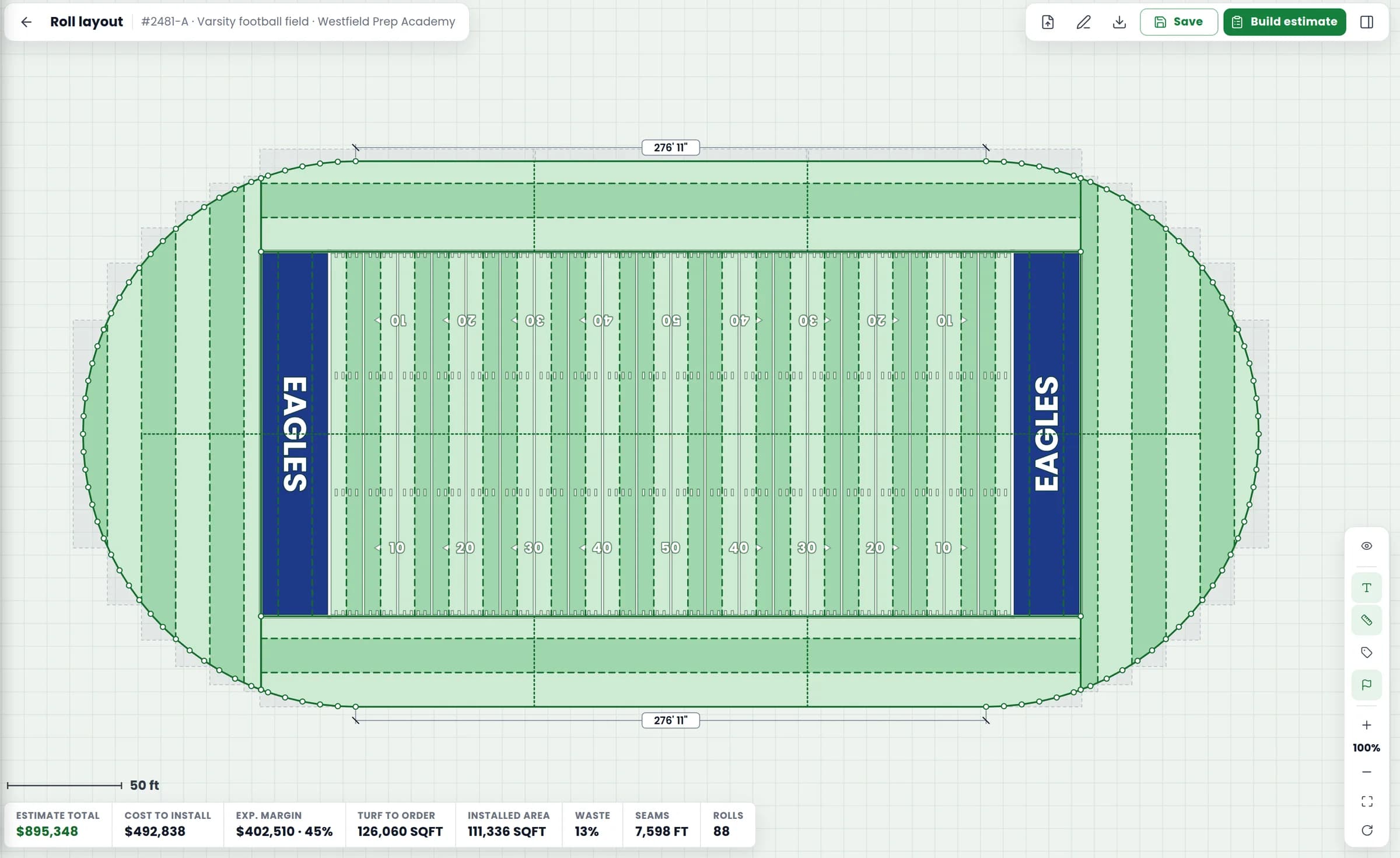
The fringe is where waste climbs. A 2 ft ring around a curved green gets cut out of 15 ft wide turf, so you throw away a lot of the middle. On small rings, ordering two or three times the fringe area is normal. Lay it out and price the waste instead of hoping it is low. In TurfEstimator, the roll layout handles a putting green and more than one turf type in the same yard, so each turf gets its own rolls, seams and waste.
Base, contours and compaction
The base is where a green is made or ruined. A lawn needs to be flat enough. A green needs to roll true, and any soft spot shows up as a break that was not designed in.
- Excavation: typically the same 3 to 4 inches as a lawn, sometimes more where you need to build up a contour.
- Base rock: crushed rock compacted in lifts, typically 3 to 4 inches, plus extra wherever you build a mound or tier.
- Top layer: a fine finish layer, like screened decomposed granite or rock dust, about an inch or so, to shape the breaks and get a smooth surface.
- Compaction: a plate compactor on every lift, then a roller or hand tamp on the finish layer, with water as needed. Then check it with a ball before the turf goes down.
Contours cost in three places: more base material, more compaction passes and more hours with a rake and level. Price them as their own line or as extra labor, so a customer who wants two tiers and a ridge pays more than one who wants a gentle slope.
Plan the drainage as part of the shape. Water has to run off the surface and out of the base, not pool in the low cup.
Cups, infill and seams on a green
Cups and flags are a simple line item, but count everything: the cup, the flag and pole, and any ferrules or covers. Most backyard greens have two to four cups. Set them before the infill so the turf around each cup sits flat.
Infill on putting turf is usually sand, and the amount controls the ball speed and how the surface plays. Follow the turf manufacturer's spec for pounds per sqft. Some putting turfs need a lot of sand and some need little or none. The fringe turf has its own spec, so figure the two separately and buy whole bags.
Seams on a green follow different rules than a lawn:
- Keep seams on the putting surface out of putting lines. A ball that crosses a seam can hop or break.
- If a seam on the surface cannot be avoided, run it where few putts travel, like along the back edge, and away from the cups.
- Price the green-to-fringe joint as a seam. On a 320 sqft green that can be 70 ft of seam tape and glue, plus careful cutting.
- Plan more turf before you plan a bad seam. A few extra feet of putting turf costs less than a callback.
Labor is higher per sqft
A green takes more hours per sqft than any lawn you install. Shaping and checking contours, compacting in lifts, cutting the green to shape, gluing the fringe joint by hand, setting cups and working the sand in all take time, and none of it gets faster with a bigger crew.
Use your own timesheets on past greens if you have them. If you do not, assume a two or three person crew spends most of two days or more on a 300 sqft green with fringe, and adjust for the contours and access. Track the real hours on every green you build so the next estimate is right. With TurfEstimator's GPS time clock, the crew clocks in on site from their phones and the hours land on timesheets, so your past greens tell you what the next one will take.
Tip: If you sub out the green to a specialist, put their price on the estimate as a line item and add your own margin on it.
A worked example: a 320 sqft backyard green
Say a made-up customer wants a 320 sqft kidney shaped green, 14 ft at its widest, with three cups, a gentle two-level break and a 160 sqft fringe ring. The green fits in one 15 ft roll at 25 ft long, 375 sqft, with no seam on the putting surface. The fringe ring takes a 15 ft by 20 ft piece, 300 sqft, so it has a lot of waste. The green-to-fringe joint is about 70 ft.
All prices are example numbers. Use your own.
| Line item | Quantity | Your cost |
|---|---|---|
| Putting turf | 375 sqft at $3.25 | $1,219 |
| Fringe turf | 300 sqft at $2.25 | $675 |
| Base rock, incl. contour build-up | 7 cu yd at $45 | $315 |
| Fine finish layer | 1 cu yd | $60 |
| Weed barrier | 1 roll | $60 |
| Seam tape and glue | about 70 ft | $90 |
| Nails | 1 box | $40 |
| Cups and flags | 3 at $45 | $135 |
| Sand infill, green and fringe | 26 bags at $9 | $234 |
| Equipment | compactor, roller | $250 |
| Excavation, dump fees, trucking | 480 sqft | $300 |
| Labor | 48 hr at $30 | $1,440 |
| Overhead share | crew days | $500 |
| Total cost | $5,318 |
At a 40% gross margin, the price is $5,318 divided by 0.60, which is $8,863. Round to $8,875. That is about $18.50 per sqft of the whole area, or about $27.75 per sqft of the putting surface alone. A lawn price per sqft applied to this green would have been thousands short.
Price greens by the job, not only per sqft
Per sqft pricing works on big flat lawns because the cost scales with the area. Greens do not scale that way. Cups, the fringe joint, the contours and the setup cost about the same on a 200 sqft green as on a 400 sqft one. Price per sqft alone and the small greens lose money while the big ones win you too many jobs.
- Set a minimum price for any green, built from a small green's real cost.
- Price contours and extra cups as add-ons, so the customer sees what each one costs.
- When the green is part of a bigger yard, show it as its own option or package so the customer can say yes to the lawn and decide on the green.
TurfEstimator builds the estimate from the layout, sizing the putting turf, fringe turf, seam tape, base and infill, and shows the cost to install and the expected margin before you send it. You can offer the green as an add-on or a good, better and best option, and the customer can e-sign and pay the deposit from their phone.
Questions installers ask
How much does a putting green installation cost?
It depends on the size, the contours, the turf and your market, so build it from line items instead of a per sqft guess. Small greens cost much more per sqft than lawns because cups, contours, the fringe joint and setup do not shrink with the area. Set a minimum job price that covers a small green.
Do I need a separate fringe turf around a putting green?
Most installs use a fringe or lawn turf around the putting surface, because putting turf alone looks unfinished at the edge and does not hold a chip shot. The fringe is a separate product with its own price, layout and infill. Price the joint between them as a seam.
How much sand infill does a putting green need?
It depends on the turf. Some putting turfs take a lot of sand and some take little or none, and the amount changes the ball speed. Follow the manufacturer's spec in pounds per sqft for the putting surface and figure the fringe separately.
Where should seams go on a putting green?
Out of the putting lines and away from the cups. Pick a roll width and direction that lets the putting surface fit in one piece if you can. If a seam has to be there, run it along the back edge or another spot few putts cross.
How many cups should a backyard putting green have?
Most backyard greens have two to four. More cups give more putts to practice but crowd a small surface. Place them using the contours so each cup gives a different putt, and price each one as a line item.