
Guides / Estimating
How to bid an artificial turf football field
A football field is a backyard job times a hundred, with a bid deadline. Here is how to read the plans, lay out every roll, run the takeoff and send a number you can stand behind.
By Josh West, co-founder of TurfEstimator | November 22, 2026 | 9 min read
A synthetic turf football field is the biggest single job most turf installers ever bid. It is over 100,000 square feet of turf inside a track, with lines and lettering in it, and a bid date that does not move. Get the roll layout wrong by a few percent and the miss is a truckload of turf, not a few square feet of scrap.
The good news is that a field is more predictable than a backyard. The sizes are standard, the way the rolls go in is well known, and the takeoff follows from the layout. Here is how to bid a high school football field, step by step.
Key takeaways
- Read the bid documents first. Know what is in your scope (turf, pad, infill, base, markings) before you lay a single roll.
- A field is installed in parts: the inner field, two sidelines and two D zones, each with its own roll direction.
- Lay out the rolls before you price. The turf to order on a field is well above the installed area, and the curves at the ends cause most of it.
- Size the pad, infill, seam tape and nail board from the layout, so the takeoff and the roll plan always agree.
- Send a bid with the field plan, the numbers and clear alternates, so the school compares like with like.
Read the bid documents before you lay a roll
A school field usually comes with plans and a written spec. Read both and write down what is yours to price and what is somebody else's. Two contractors who read the scope differently will be far apart on price, and only one of them is right.
Work through the spec with a list like this:
- The turf system, shock pad and infill: the products, thickness and pounds per square foot the spec calls for.
- Base and drainage: whether the stone base, grading and drains are yours or the site contractor's.
- Markings: which lines, colors, lettering and logo, and whether they are tufted in at the factory, inlaid on site or painted.
- The D zones: whether they are turf, or concrete pads and field events like a long jump runway.
- Alternates: options the school wants priced separately, like a second color on the sidelines.
Know the field you are pricing
A football field is 360 by 160 ft inside the lines, end zones included. That is the same at the high school and college level. What changes between them is where the hash marks go: 53 ft 4 in from each sideline at high school, 60 ft at college.
Most school fields sit inside a 400 meter running track. The turf stops at the track's inside edge, which on a standard track is about 239 ft 6 in by 516 ft 5 in, with rounded ends. So the turf is not a rectangle. It is the playing field, plus the run-off past the lines, plus the curved ends.
Field turf is installed in five parts, and it helps to bid it the same way:
| Part | Where it is | Which way the rolls run |
|---|---|---|
| Inner field | The playing field and both end zones, plus any turf past the lines | Sideline to sideline |
| Two sidelines | The strips along each long side, out to the track | Along the field, turned 90 degrees from the inner field |
| Two D zones | The curved ends between the end lines and the track | The same way as the inner field |
Each part can carry its own turf, such as a different color on the sidelines, so price each part as its own area.
How the rolls go in
Field turf usually comes in 15 ft wide rolls, and 15 ft is exactly 5 yards. That is why the inner field runs sideline to sideline: each roll lines up with the 5-yard lines, and a field made with lines tufted in at the factory goes together like a striped puzzle. The usual start is the first roll centered on the 50-yard line, so both halves of the field match.
The sidelines turn 90 degrees and run along the field. They are long, so one roll rarely covers the length. Where one roll ends and the next begins you get a butt seam across the strip, and the longest roll length you can get decides how many of those there are.
The D zones run the same way as the inner field, on the same seam lines, and get cut to the curve of the track. This is where most of the trim comes from. A square-ended roll cut to a curve leaves a wedge of scrap on every piece, and a field with two turfed D zones has dozens of those cuts.
These directions are where a field starts, not rules. If the spec calls for something else, turn a part's rolls and compare the turf to order both ways.
Tip: If a D zone is concrete, a building or field events, take it out of the turf before you order. Leaving it in is the easiest way to buy thousands of square feet you will never install.
Lay out the field before you price it
On a field, square feet plus a waste factor does not work. The gap between the turf you install and the turf you buy depends on the D zones, the longest roll you can get, the end trim and how the sidelines break.
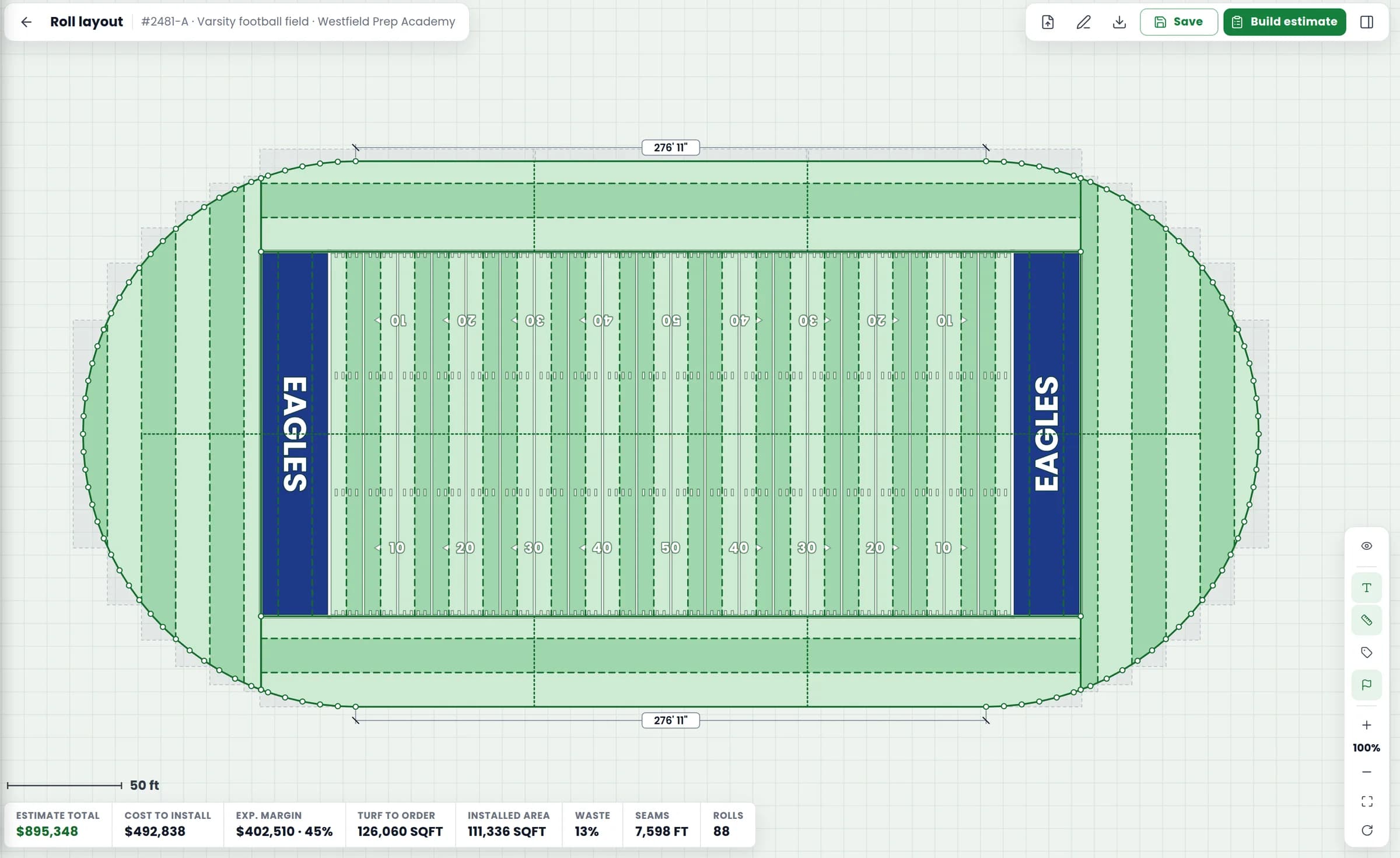
In TurfEstimator's roll layout, a football field drops onto the plan as a high school field inside a standard track, already split into the inner field, sidelines and D zones, with every roll laid the way installers lay them. Change the level, the field size, the turf past the lines or the track's inside edge, and the field is laid again. A switch on each D zone takes it out of the turf.
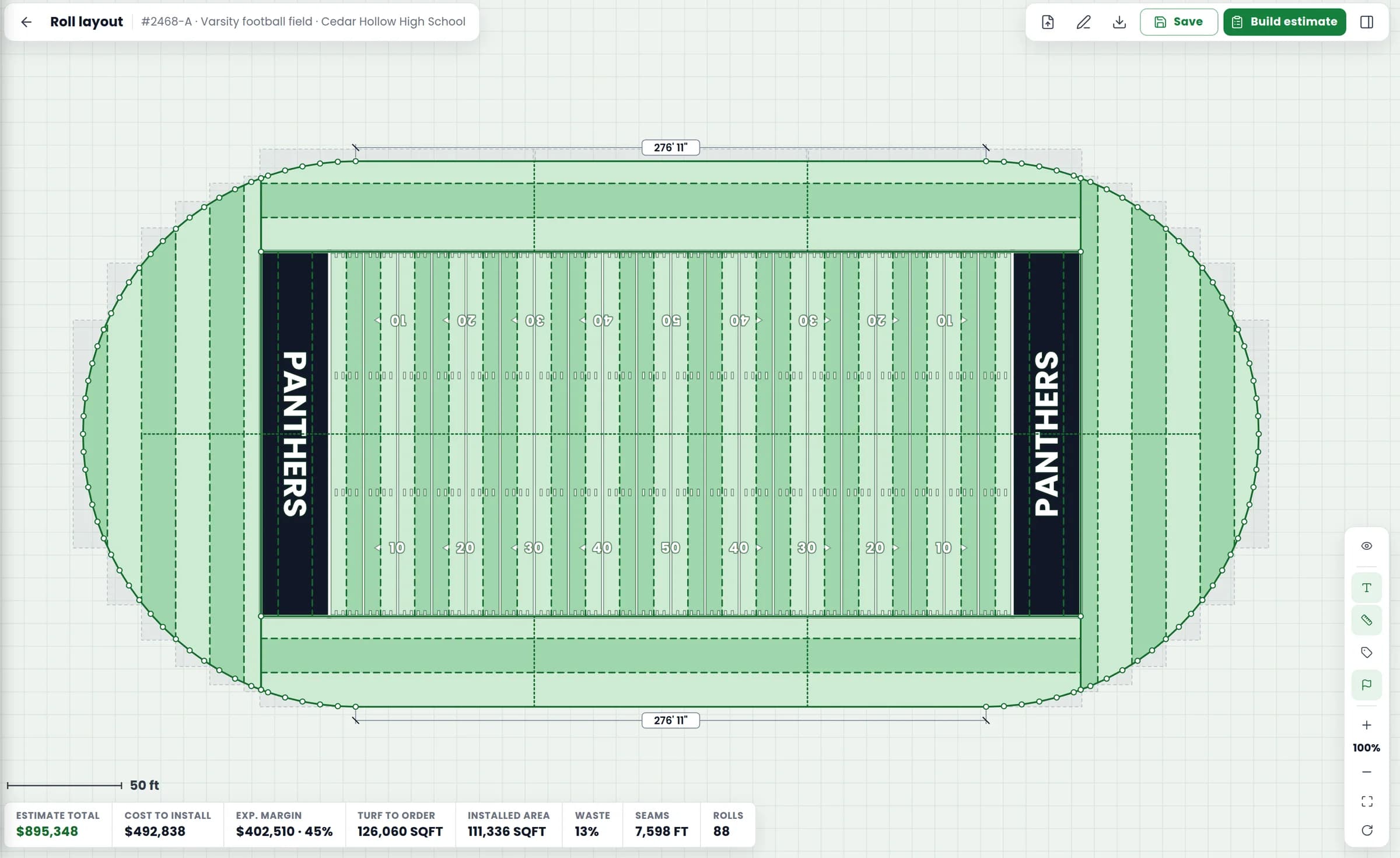
Example: the sample high school field above, with both D zones turfed, comes to 88 rolls, 7,598 ft of seams and 126,060 sqft of turf to order for 111,336 sqft installed, which is 13% waste. The school and prices in the picture are made up, but the numbers show the point: on a field this size, 13% is about 14,700 sqft of turf, and it has to be on the order and in the price.
Price the markings as their own items
Yard lines, numbers, hash marks, end zone color and lettering, a logo at the 50, and soccer or lacrosse lines in another color are a big part of what the school is buying. They do not change how the rolls are laid, but they do change the price.
Price each one as its own line, at what it costs you to make and install. Then show them on the plan, so the athletic director can check the lettering and logo before the turf is made.
Run the takeoff from the layout
The turf is only part of a field. Pad, infill, seam tape and nail board all scale with it. Size each one from the layout, not from a separate count off the drawing, so the takeoff and the roll plan always agree.
| Line item | Sized from | In the example |
|---|---|---|
| Field turf | Turf to order, trim and waste included | 126,060 sqft |
| Shock pad | Installed area | 111,336 sqft |
| Infill sand and rubber | Installed area, at the spec's pounds per sqft | From the spec |
| Seam tape | Seam length, at the feet one roll covers | 7,598 ft, or 24 rolls at 325 ft each |
| Nail board | The edge length around the turf | From the layout |
| Install labor | Installed area, at your own rate | Your rate |
| Lines, lettering and logo | Each one, priced on its own | Your price |
In TurfEstimator you set this up once per product: say whether its quantity comes from the turf to order, the installed area, the seam length or the edge, and how much one bag, roll or bucket covers. Build the estimate from the layout and every product is sized for this field, rounded up to whole units.
Then put your purchase cost on each product. The layout shows the cost to install and the expected margin before you send anything, so you can see what a different turf or a D zone left out does to the job.
Start from the site plan when there is one
Some fields are not standard: a short run-off at one end, or a track that is not quite 400 meters. When the drawing and the standard field disagree, the drawing wins.
- Import the plan. A CAD file (DXF) or a point list (CSV) comes in at its own measurements. A picture of the plan (PNG or JPG) works too; save a PDF page as a picture first.
- Trace the field's outline, or let Turf AI read the picture. It finds the turf and the scale in about half a minute.
- Select the outline and make it a football field. The turf edge stays as drawn, and the field's sizes, end zones and lines can be read from the drawing for you to check.
- Nudge the lines to sit on the drawing, then check the size against the plan's own numbers. On a field, a scale off by a little is a lot of turf.
Send a bid the school can read
Your bid is often read by an athletic director and an architect. Give them a plan they can check against the spec, not only a number.
- The field plan: rolls, seams, markings, end zone lettering and logo, drawn to scale.
- The base bid, then each alternate priced on its own, like a second turf on the sidelines or a D zone left out.
- What is not included, in plain words, such as the stone base or drainage when they belong to the site contractor.
Keep the cut list for your crew and supplier. On award day, the order and the install plan are already done, because they came from the same layout as the bid.
Soccer and baseball fields
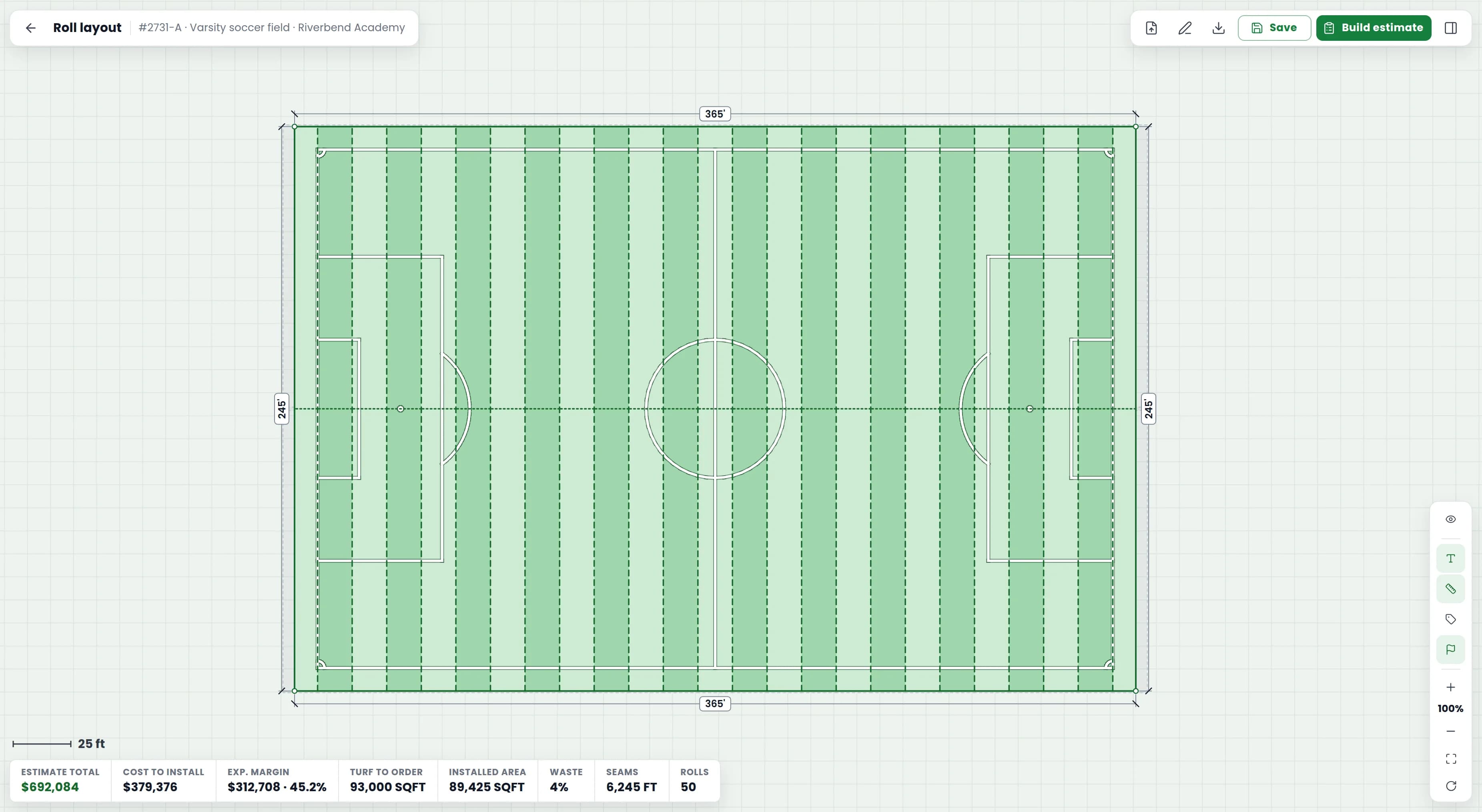
A soccer field is simpler: one piece of turf, usually rolled sideline to sideline and centered on the halfway line. Common sizes are 115 by 75 yards, 120 by 80 yards and the FIFA 105 by 68 meters, with turf running past the touchlines and goal lines. Rolls can also run goal to goal, so compare the turf to order both ways.
Baseball and softball fields have their own logic. The infield runs from home plate toward center field, the foul ground runs in long strips down each foul line, and the outfield and warning track go whichever way uses the least turf.
TurfEstimator lays out football, soccer and baseball fields this way, so a field bid goes out in an afternoon instead of a week in CAD.
Questions installers ask
How much turf does a football field need?
The playing field is 360 by 160 ft, 57,600 sqft, but most school fields are turfed out to the inside of the track, about 111,000 sqft inside a standard 400 meter track. The turf to order is higher still, because of trim on every roll and the cuts around the curved ends. Lay out the rolls to get the real number for your field.
Which way do the rolls run on a football field?
On the inner field the rolls usually run sideline to sideline, so 15 ft rolls line up with the 5-yard lines. The sidelines are turned 90 degrees and run along the field. The curved D zones at the ends run the same way as the inner field.
Why is the waste so high on a field with a track?
Most of it comes from the curved ends. Straight rolls cut to a curve leave scrap on every piece. If a D zone is concrete or field events, leaving it out of the turf lowers the order.
What goes into a sports field turf takeoff?
The turf to order, shock pad, infill, seam tape and adhesive, the nail board or edge fastening, install labor, and the lines, lettering and logo. Base and drainage are sometimes in the turf contractor's scope and sometimes the site contractor's, so check the bid documents.